For most healthy adults, creatine doesn't need a special water number: drink your normal daily target, which is roughly 30 to 35 ml per kilogram of body weight (about 2.3 litres, or 78 fl oz, for a 70 kg person), plus about half a litre for every hour you train. Research hasn't found that creatine dehydrates you, so you're aiming to drink consistently, not to drown yourself.
I'm Sanket, and I make Hydration Hero, a water tracker app, at my studio in Melbourne. I'm not a doctor or dietitian, so this guide sticks to the research and official guidelines (sources at the bottom). For your own number, use our free water intake calculator.
What's the short answer?
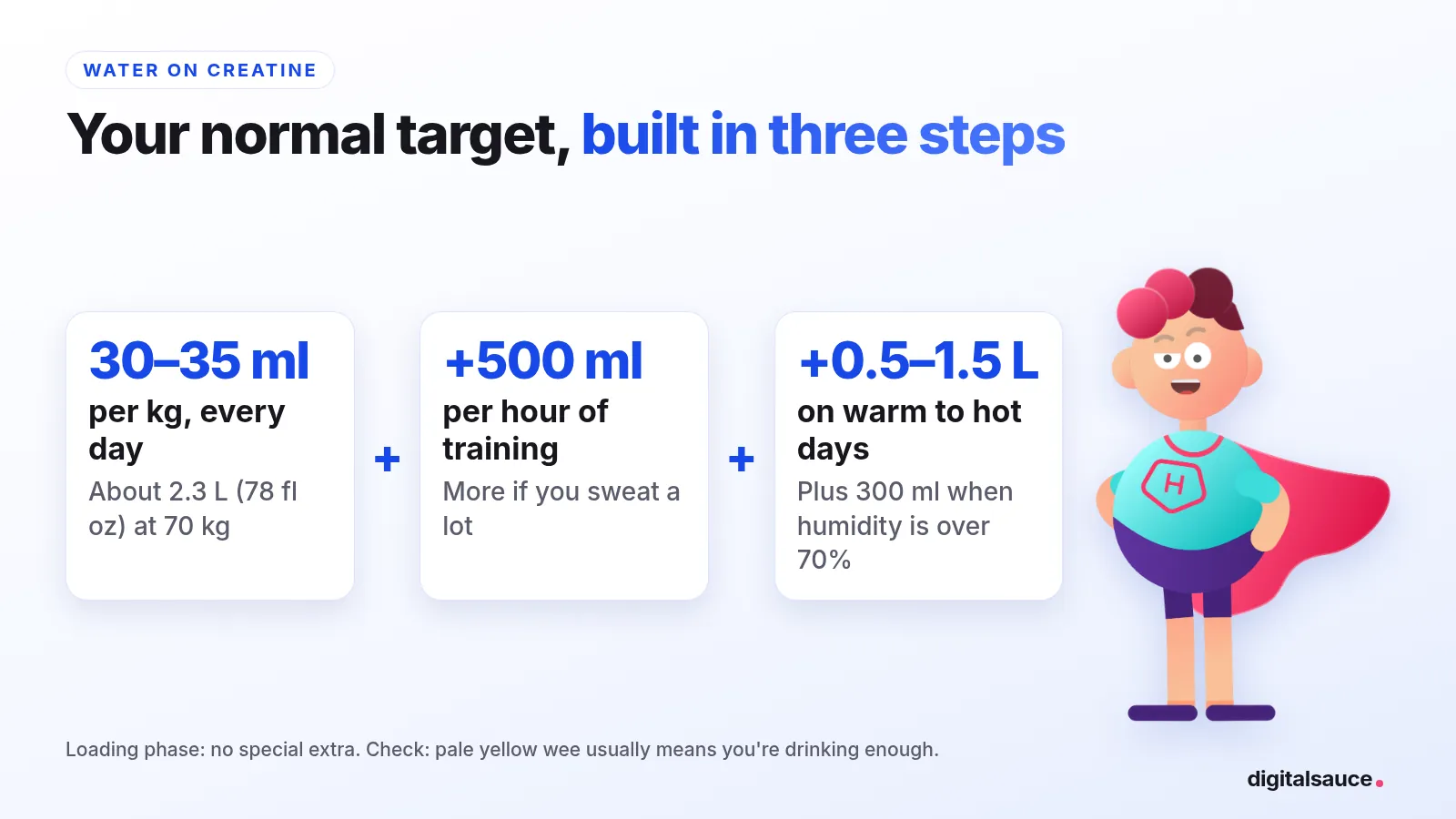
The creatine water rule of thumb
- Every day: about 30 to 35 ml of fluid per kg of body weight. That's about 2.3 L (78 fl oz) at 70 kg.
- Training days: add about 500 ml (17 fl oz) for each hour of exercise, more if you sweat a lot.
- Warm, hot and humid days: our calculator adds 500 ml at 20 to 28°C, 1 litre at 28 to 35°C and 1.5 litres at 35°C or hotter, plus 300 ml more when humidity is over 70%, even on a cooler day.
- Loading phase: no special extra is needed. Just don't let your normal drinking slip.
- Check: pale yellow wee usually means you're drinking enough.
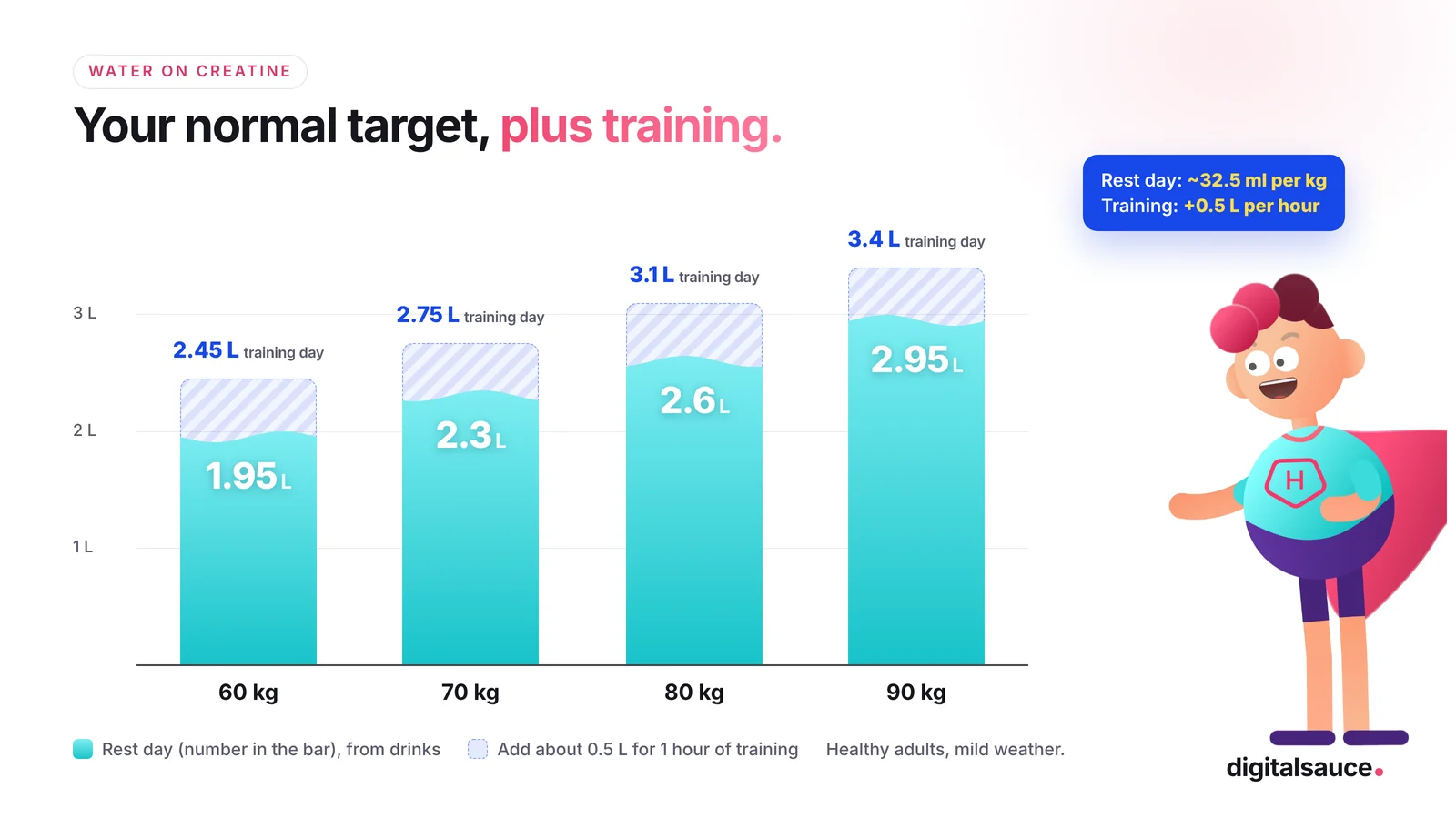
| Your weight | Rest day | Day with 1 hour of training |
|---|---|---|
| 60 kg (132 lb) | 1.95 L (66 fl oz) | 2.45 L (83 fl oz) |
| 70 kg (154 lb) | 2.3 L (78 fl oz) | 2.75 L (93 fl oz) |
| 80 kg (176 lb) | 2.6 L (88 fl oz) | 3.1 L (105 fl oz) |
| 90 kg (198 lb) | 2.95 L (100 fl oz) | 3.4 L (115 fl oz) |
Australia's NHMRC guideline is about 2.6 litres of fluids a day for men and 2.1 litres for women, counting water, milk and other drinks. The weight-based numbers land in the same range for most people and scale up if you're bigger or train harder.
Why does creatine change where your water goes?
Creatine is osmotically active: when your muscles store more of it, they hold a bit more water too. A 2021 review by the International Society of Sports Nutrition (ISSN) explains that creatine is carried into muscle cells with sodium, and water follows.
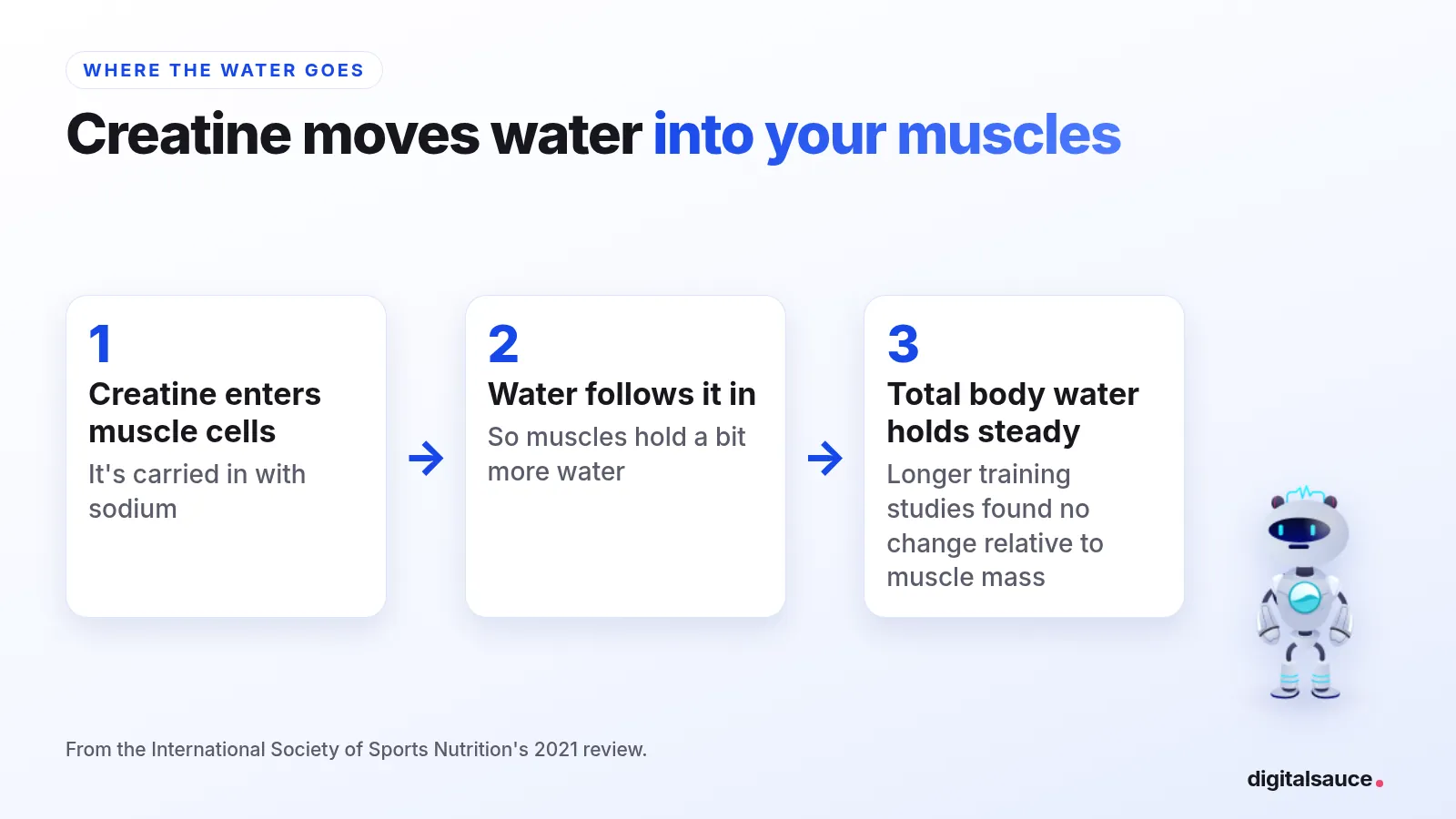
So creatine moves some water into your muscles rather than draining it from the rest of your body. The same review notes that several longer training studies found no change in total body water relative to muscle mass.
That's why the old worry about creatine "stealing" water hasn't held up. A 2009 systematic review in the Journal of Athletic Training found no evidence from controlled trials that creatine hurts fluid balance or heat tolerance at recommended doses.
Do you need more water during a creatine loading phase?
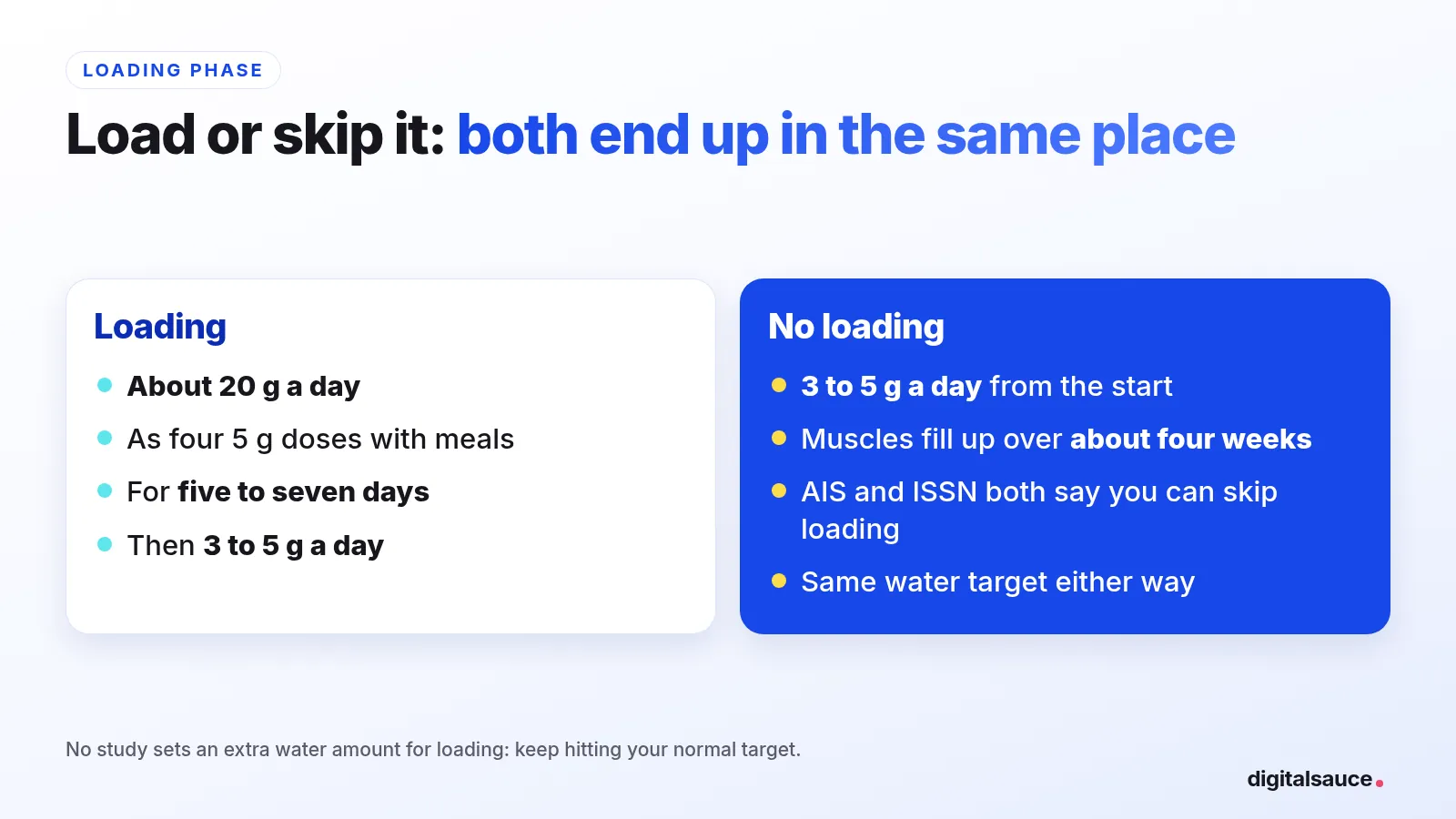
Not a special amount, but it's the week to be most consistent. Loading usually means about 20 g a day, taken as four 5 g doses with meals for five to seven days, followed by 3 to 5 g a day. The Australian Institute of Sport (AIS) and the ISSN both say you can skip loading and take 3 to 5 g a day; your muscles just fill up over about four weeks instead.
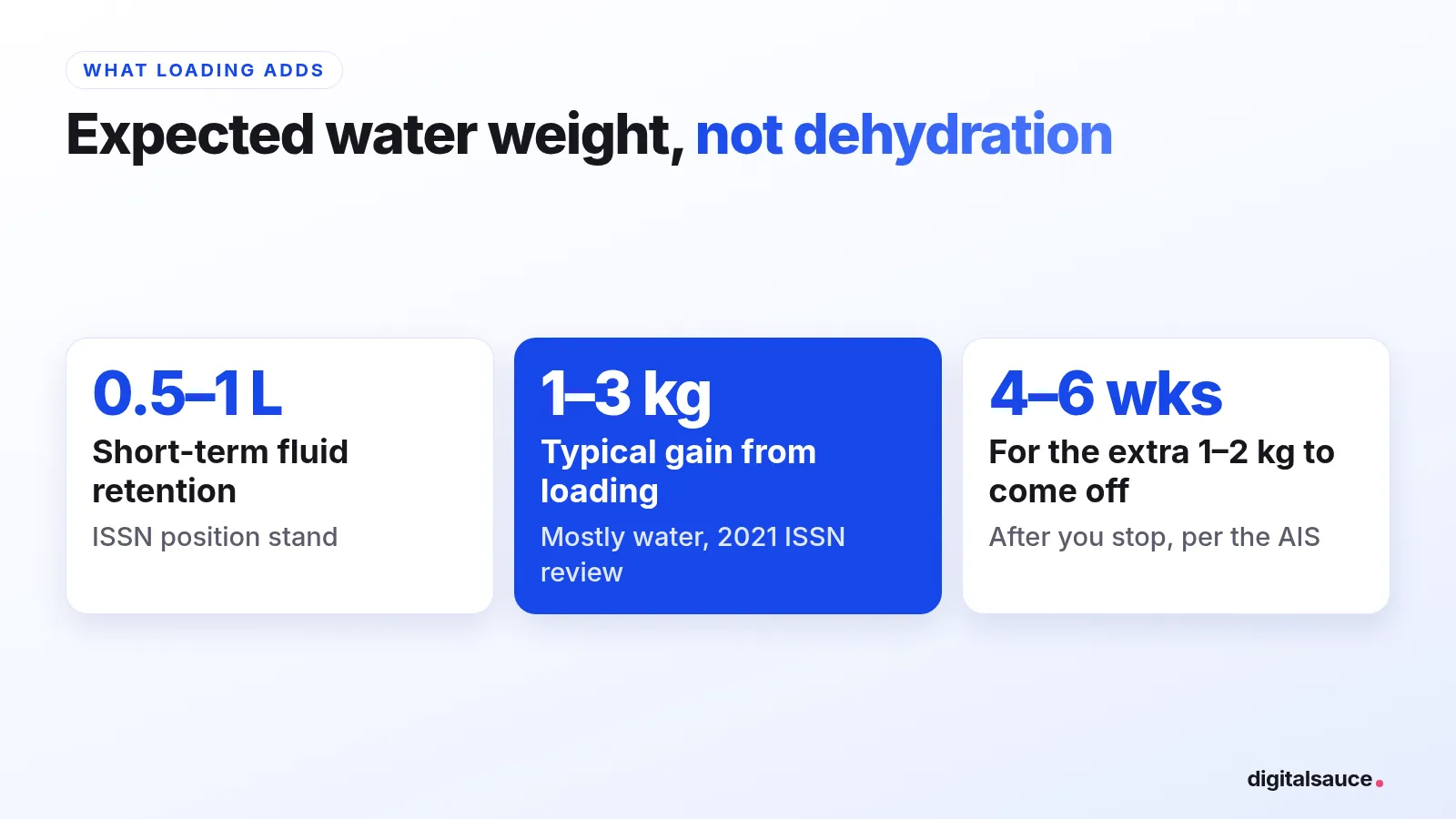
The ISSN's position stand mentions short-term fluid retention of about 0.5 to 1 litre, and the 2021 review says loading typically adds 1 to 3 kg, mostly water. That's expected, not a sign of dehydration.
I couldn't find any study that sets an extra water amount for loading. In practice: mix each dose into a drink or have it with a meal, and keep hitting your normal target. Those drinks count towards it.
Making weight for a sport? The AIS notes the extra 1 to 2 kg stays while you take creatine and takes four to six weeks to come off after you stop.
What are the signs you're not drinking enough on creatine?
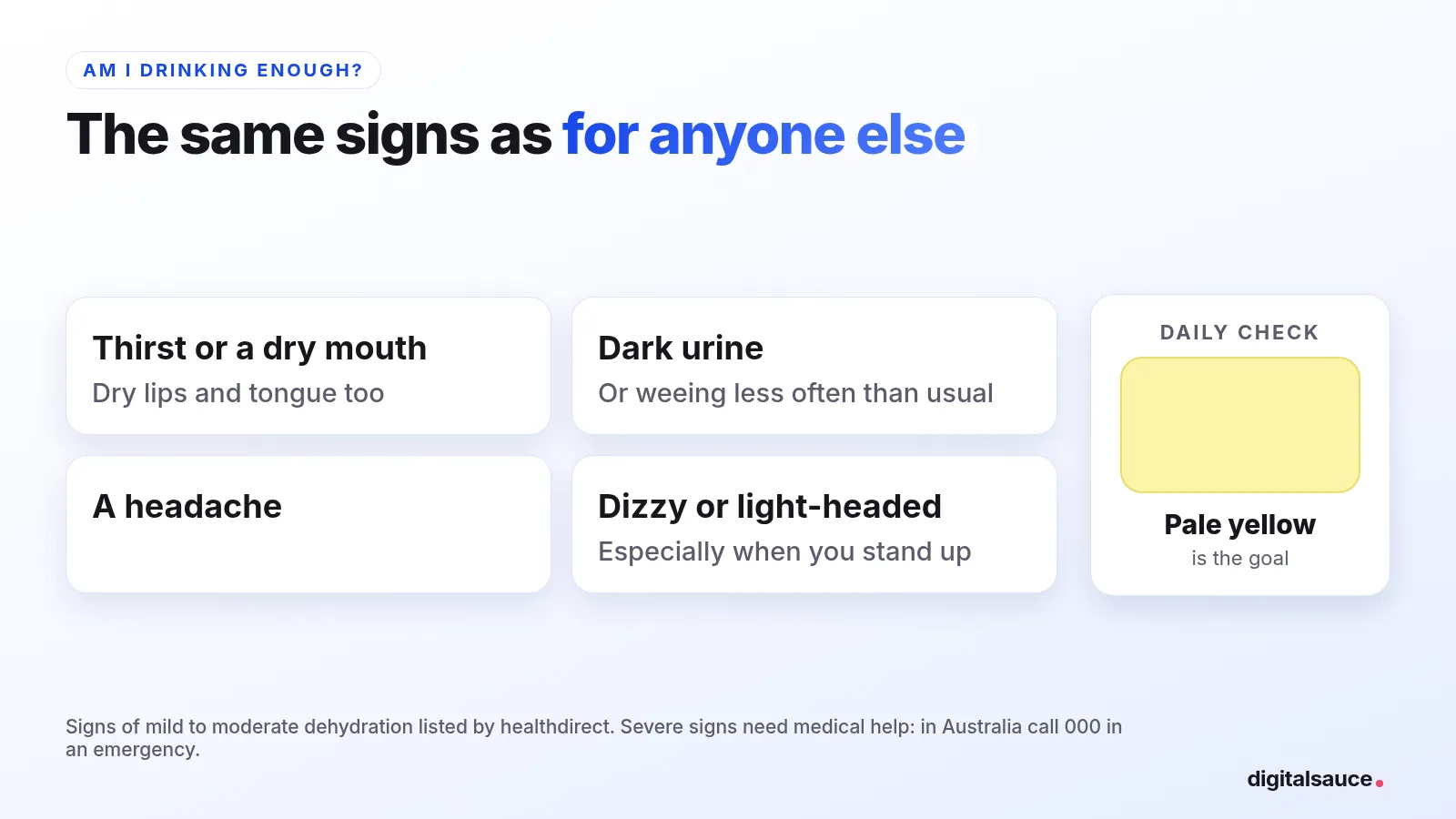
They're the same as for anyone else. healthdirect lists these signs of mild to moderate dehydration:
- feeling thirsty, or a dry mouth, lips and tongue
- dark-coloured urine, or weeing less often than usual
- a headache
- feeling dizzy or light-headed, especially when you stand up
The easiest daily check is your wee: pale yellow is the goal. Muscle cramps get blamed on creatine a lot, but the research doesn't back that up. The 2021 ISSN review describes a season-long study of college football players training in hot, humid conditions, where creatine users had less cramping than non-users, not more.
Severe dehydration is a medical problem. Signs include extreme thirst, confusion, a fast heartbeat and fast breathing, or not weeing at all. In Australia, call 000 in an emergency, or healthdirect on 1800 022 222 for advice.
How should training, hot weather and coffee change your target?
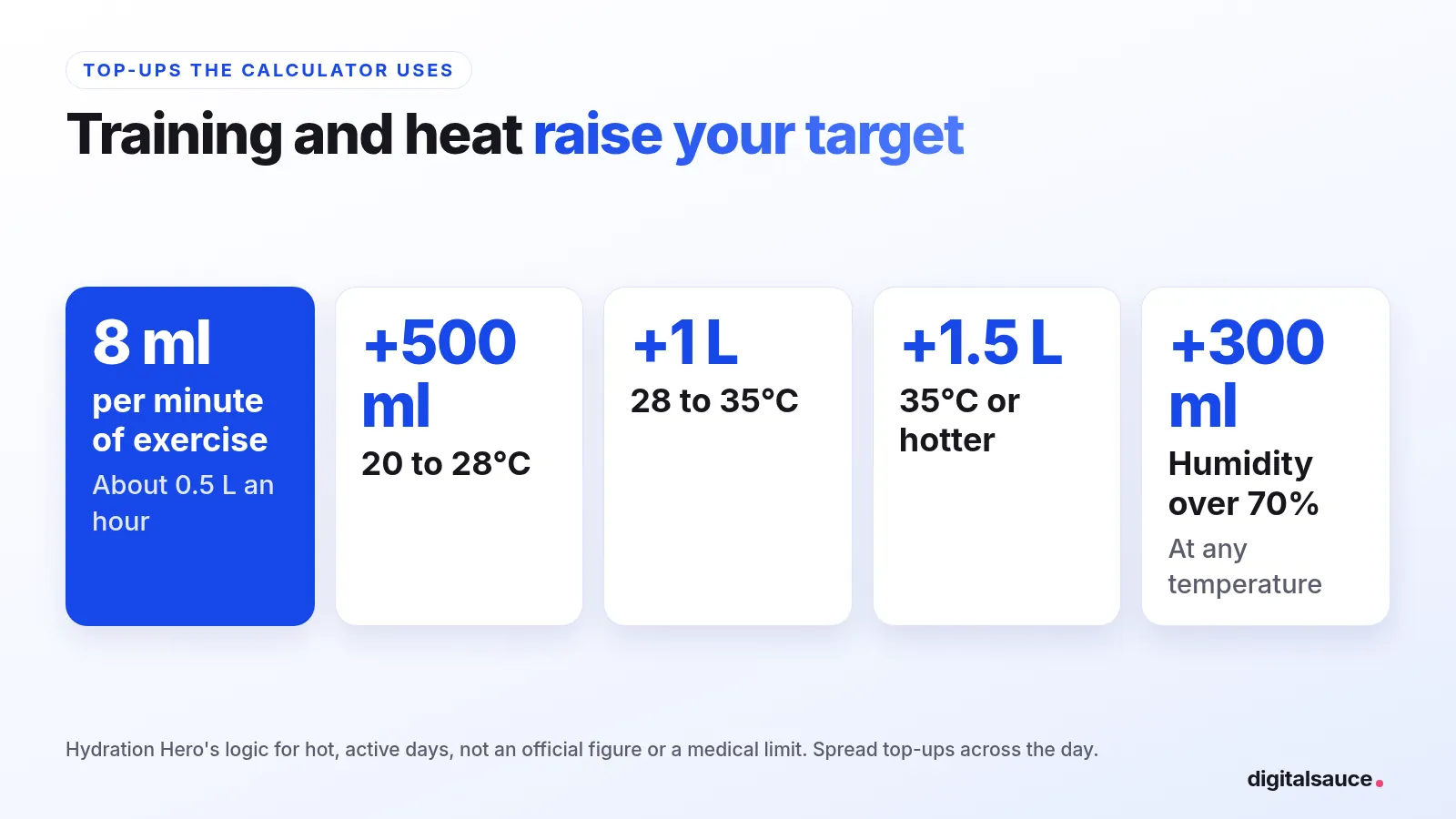
Training. Our calculator adds 8 ml per minute of exercise, about half a litre an hour, as a cautious starting point. The American College of Sports Medicine notes that sweat rates vary hugely, so if you finish sessions soaked, drink more. Creatine doesn't change this part.
Hot weather. Our calculator uses the same weather top-ups as Hydration Hero: 500 ml at 20 to 28°C, 1 litre at 28 to 35°C and 1.5 litres at 35°C or hotter, plus 300 ml more when humidity is over 70%. The humidity top-up applies at any temperature, so a humid day under 20°C still adds 300 ml. They're my app's logic for hot, active days, not an official figure or a medical limit, so spread any top-up across the day rather than forcing it down. If you have a heart or kidney condition or you're on a fluid restriction, follow your doctor's advice instead. Creatine doesn't seem to hurt how you handle heat, but you still need to drink for it.
Coffee. It counts. A 2014 study of regular coffee drinkers found that moderate coffee hydrated about as well as water. healthdirect says healthy adults can safely have around 400 mg of caffeine a day, which is roughly four instant coffees. See does coffee count as water? for more on that.
What does a day of drinking on creatine look like?
Here's a training day for a 70 kg person aiming for 2.75 litres. The times are loose; the point is to spread drinks out so you're not chugging a litre at 9 pm.
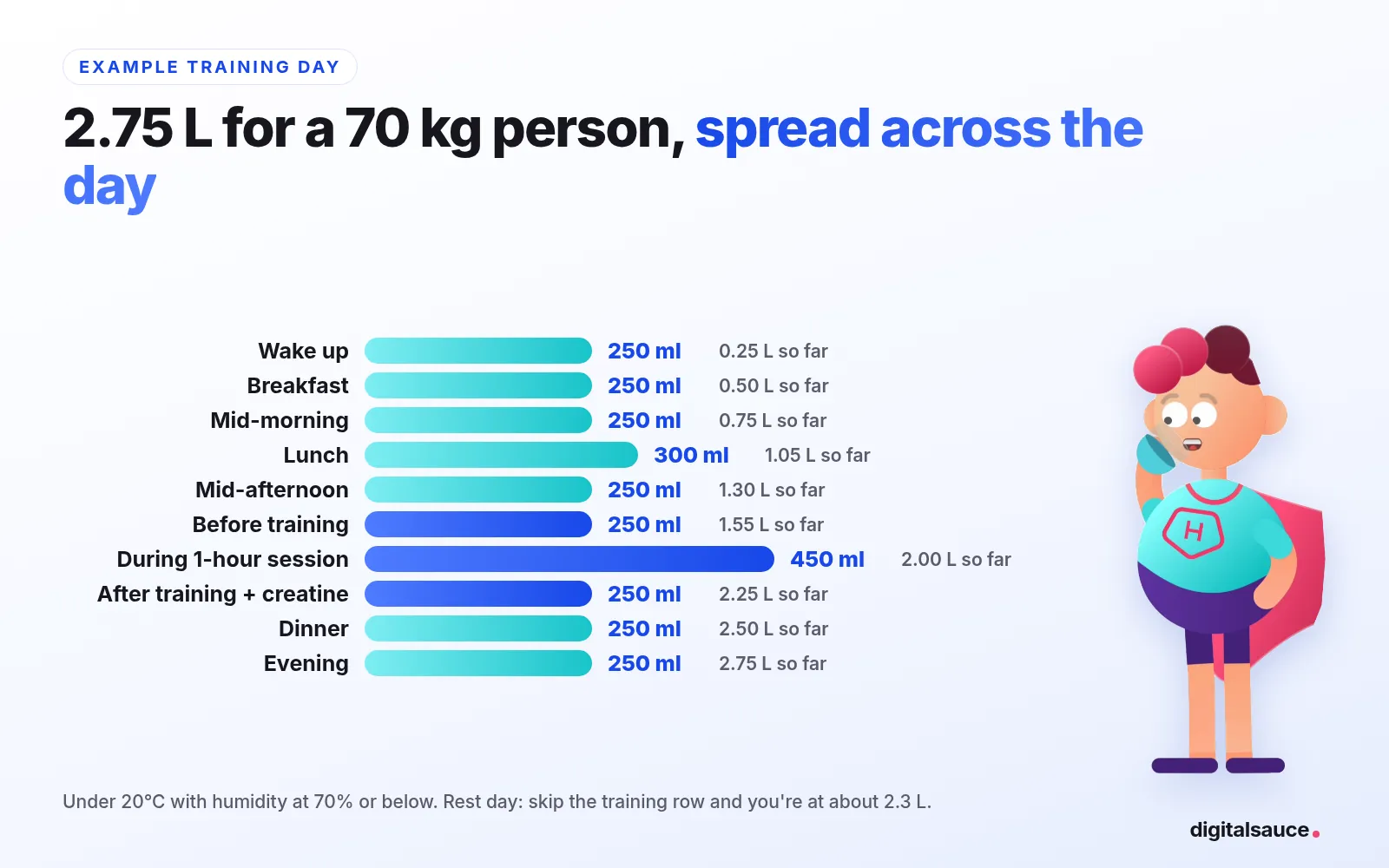
| When | What | Millilitres | US fl oz |
|---|---|---|---|
| Wake up | Glass of water | 250 ml | 8.5 fl oz |
| Breakfast | Coffee or tea (it counts) | 250 ml | 8.5 fl oz |
| Mid-morning | Water bottle | 250 ml | 8.5 fl oz |
| Lunch | A big glass of water | 300 ml | 10 fl oz |
| Mid-afternoon | Water | 250 ml | 8.5 fl oz |
| Before training | Water | 250 ml | 8.5 fl oz |
| During a 1-hour session | Sip from your bottle | 450 ml | 15 fl oz |
| After training | Recovery shake or water with your meal, with your 3 to 5 g of creatine mixed in | 250 ml | 8.5 fl oz |
| Dinner | Water | 250 ml | 8.5 fl oz |
| Evening | Herbal tea or water | 250 ml | 8.5 fl oz |
| Total | 2.75 L | 93 fl oz |
The AIS suggests taking creatine with a meal that has carbohydrate in it, and after training is a handy time. Drink it straight away once mixed: the AIS says creatine quickly breaks down in liquid.
How do you actually hit your water number every day?
Knowing your number is easy. Remembering to drink it on a busy day is where most people slip. What helps:
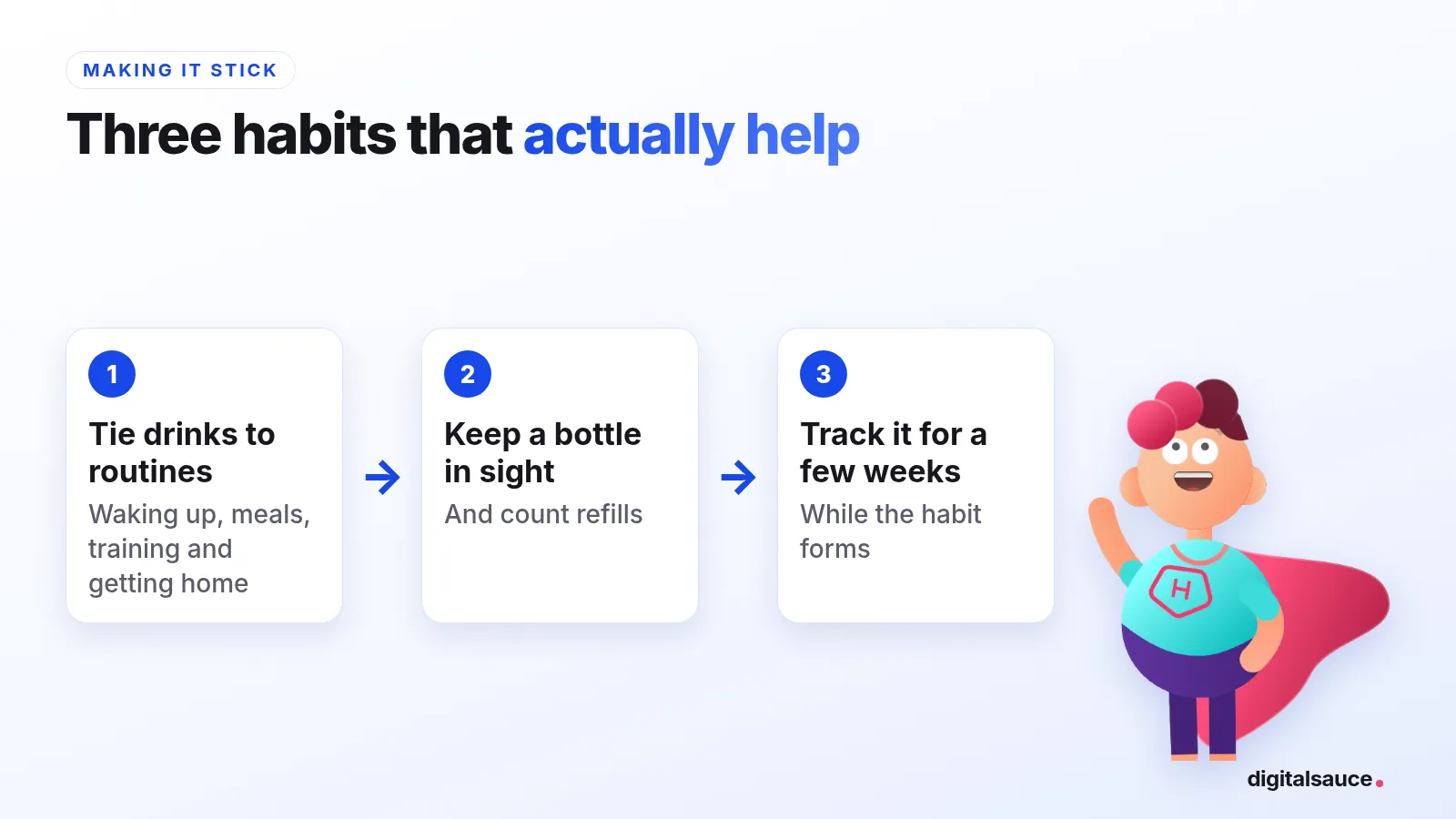
- Tie drinks to things you already do, like waking up, meals, training and getting home.
- Keep a bottle in sight and count refills.
- Track it for the first few weeks while the habit forms.
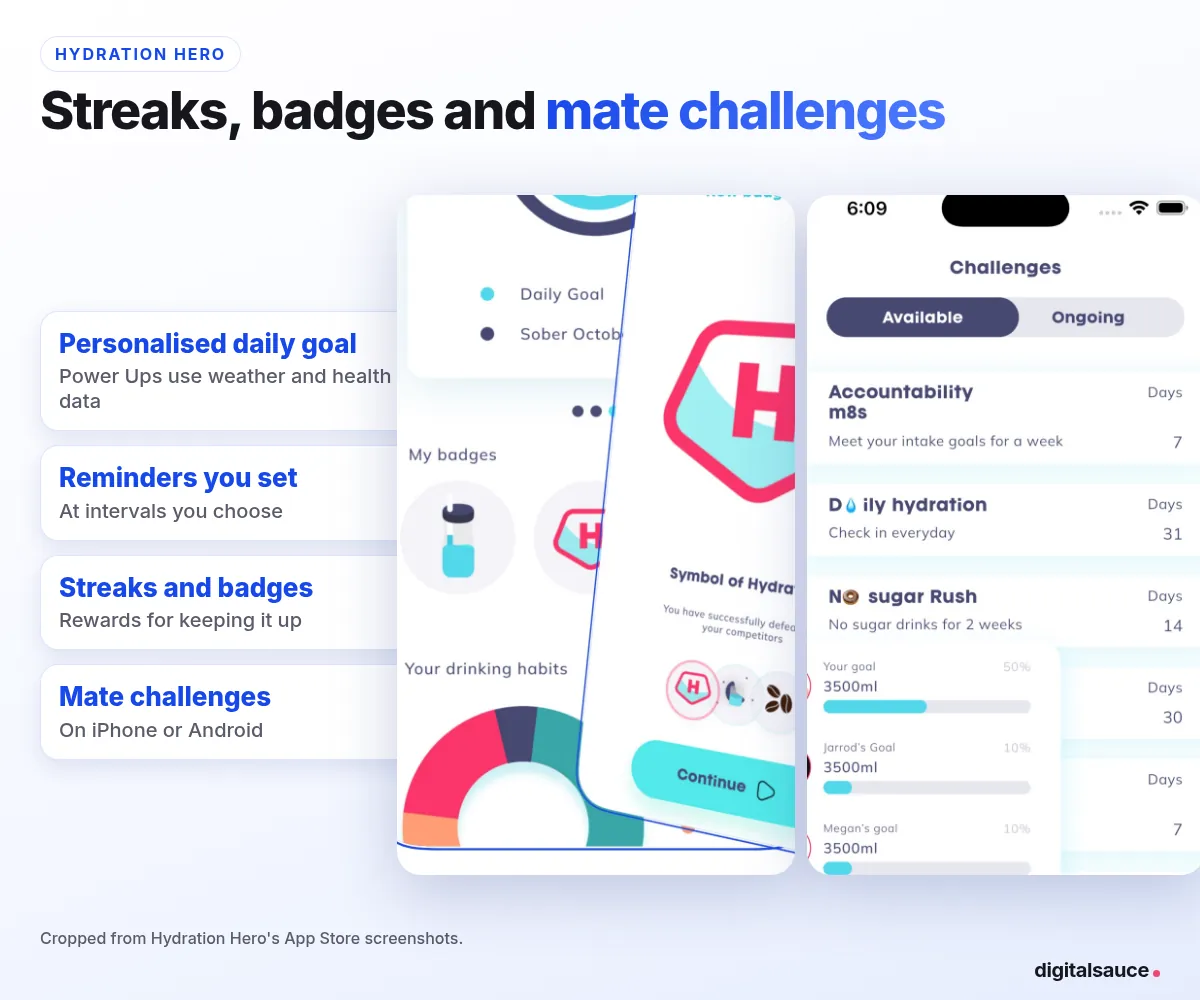
That last one is why we built Hydration Hero. You set a personalised daily goal, it sends reminders at intervals you choose, and you log each drink as you go. Streaks and badges reward you for keeping it up, and you can challenge your mates. A hero character you design reacts every time you drink, and Power Ups use weather and health data (from Apple Health on iPhone or Health Connect on Android) to give you a more tailored daily goal. It's free on iPhone and Apple Watch (the iPhone app also runs on iPad) and on Android.
Not a fit if you'd rather not use an app at all. A marked bottle and the wee check work fine for lots of people.
Start with your number: the water intake calculator works it out from your weight, exercise and the weather.
Who should check with a doctor before taking creatine?
Creatine is one of the most researched supplements around. The ISSN's position stand reports that short- and long-term use is safe and well tolerated in healthy people at recommended doses, and the AIS puts it in its Group A list of supplements with strong evidence. That's about healthy people, though. Talk to your GP before you start if you:
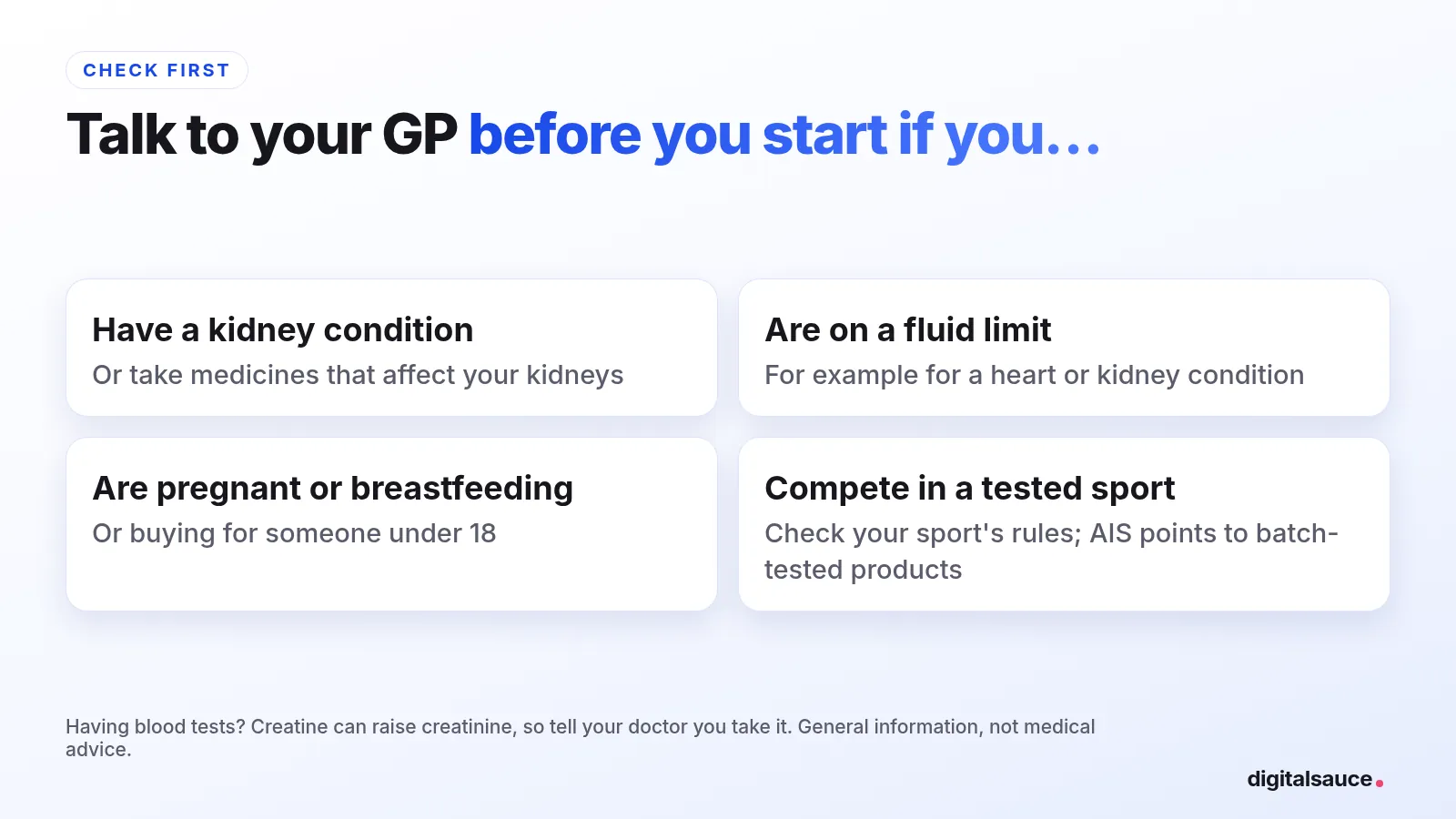
- have a kidney condition, or take medicines that affect your kidneys;
- have been told to limit how much fluid you drink, for example because of a heart or kidney condition;
- are pregnant or breastfeeding, or are buying for someone under 18;
- compete in a tested sport. Check your sport's supplement rules first, and note that the AIS points athletes to batch-tested products.
One practical tip from the 2021 review: creatine can raise creatinine, a marker on routine kidney blood tests, without meaning your kidneys are in trouble. If you're having blood tests, tell your doctor you take creatine.
This is general information, not medical advice. If you're unsure, ask your GP or an accredited sports dietitian. In an emergency in Australia, call 000.
Frequently asked questions
Does creatine dehydrate you?
No, not according to the research so far. Creatine draws a little extra water into your muscles, but a 2009 systematic review of controlled trials found no evidence that it harms your body's fluid balance or heat tolerance at recommended doses, and the International Society of Sports Nutrition reached the same conclusion in 2021. You still need to drink your normal daily amount.
Can I take creatine with coffee?
Yes, most people can. Coffee counts towards your daily fluids, and moderate coffee hydrates about as well as water. One small 1996 study of nine men found that a high daily caffeine dose cancelled out creatine's performance benefit during loading, but a 2015 review calls the research on combining them scarce. Keep caffeine to around 400 mg a day, roughly four instant coffees, as healthdirect recommends for healthy adults.
Does creatine cause bloating?
It can make you heavier and feel a bit fuller at first, mostly from water going into your muscles. Loading at about 20 g a day typically adds 1 to 3 kg, mostly water. Some people also get an upset stomach from big single doses. Taking 3 to 5 g a day instead of loading, having it with meals, and splitting any loading doses into servings of 10 g or less can help.
How much water should I mix creatine with?
There isn't a set amount. Use enough water or another drink to mix the powder and drink it easily, such as a glass of about 250 ml, and have it straight away, because creatine breaks down in liquid. That drink counts towards your daily water target. You can also mix it into food, such as yoghurt.
Is creatine bad for your kidneys?
In healthy people taking recommended doses, research hasn't found harm to kidney function. Creatine can raise creatinine on blood tests without meaning your kidneys are damaged, so tell your doctor you take it. If you have a kidney condition or take medicines that affect your kidneys, talk to your GP before using creatine.
Related reading
- Water intake calculator: your daily water number in litres or ounces
- How much water to drink for exercise and hot weather: top-ups for training and heat
- Does coffee count as water?: what caffeine really does to hydration
- How much water should you drink a day?: the guidelines, explained
- Hydration Hero: the water tracker app with reminders, streaks and mate challenges
- All posts on the blog
Sources
- International Society of Sports Nutrition position stand: safety and efficacy of creatine supplementation in exercise, sport, and medicine (Kreider et al., 2017), Journal of the International Society of Sports Nutrition (full text free on PMC)
- Common questions and misconceptions about creatine supplementation: what does the scientific evidence really show? (Antonio et al., 2021), Journal of the International Society of Sports Nutrition
- Does creatine supplementation hinder exercise heat tolerance or hydration status? A systematic review with meta-analyses (Lopez et al., 2009), Journal of Athletic Training
- AIS Sports Supplement Framework: Group A supplements, including the creatine monohydrate practitioner fact sheet (last updated November 2025), Australian Institute of Sport
- Water: nutrient reference values, NHMRC (Eat for Health)
- Dehydration, healthdirect Australia
- Caffeine, healthdirect Australia
- Exercise and fluid replacement (ACSM position stand, 2007), Medicine & Science in Sports & Exercise
- No evidence of dehydration with moderate daily coffee intake (Killer et al., 2014), PLoS One
- Caffeine counteracts the ergogenic action of muscle creatine loading (Vandenberghe et al., 1996), Journal of Applied Physiology
- Creatine and caffeine: considerations for concurrent supplementation (Trexler and Smith-Ryan, 2015), International Journal of Sport Nutrition and Exercise Metabolism
Last updated 3 November 2026. Written by Sanket Singh, founder of Digital Sauce, from the sources above. This is general information, not medical advice. In an emergency in Australia, call 000, or call healthdirect on 1800 022 222 for health advice.