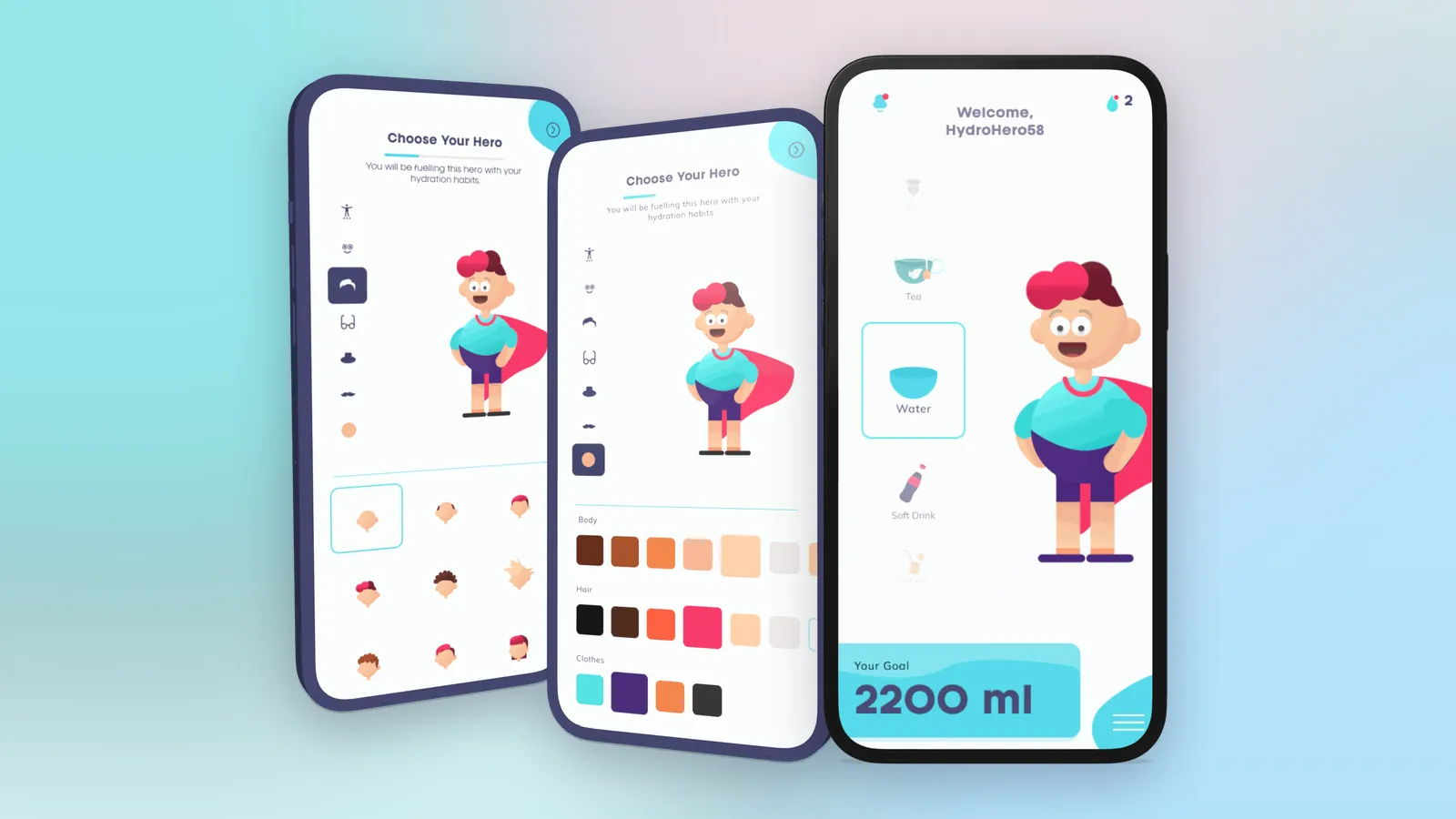
Eight glasses a day. Two litres. "Half your body weight in ounces." Everyone has a number, and almost nobody can say where theirs came from. When we were building Hydration Hero we spent a long time reading what the guidelines actually say — and the honest answer is less tidy than a slogan, but a lot more useful.
Where "eight glasses" came from
The eight-glasses rule is usually traced to a 1945 US nutrition recommendation of roughly 2.5 litres a day. The next sentence — that most of this is already contained in prepared foods — got dropped somewhere along the way, and the first half hardened into folk wisdom. There's no study that found eight glasses of plain water to be the right amount for everyone. It's a round number that stuck.
the US recommendation the eight-glasses rule is usually traced to
the total it suggested a day, from all sources
of that, it said, is already in prepared foods. That part got dropped.
That doesn't make it harmful. For a lot of people it's in the right ballpark. It just isn't your number.
What the guidelines actually say
Australia's National Health and Medical Research Council sets an "adequate intake" for total water of about 3.4 litres a day for adult men and 2.8 litres for women. Roughly a fifth of that arrives in food, which leaves around 2.6 litres of fluid for men and 2.1 litres for women from drinks. The US figures are a touch higher — 3.7 and 2.7 litres total — for the same reason: bigger average bodies.
Two things worth noticing. First, "fluid" means all of it: tea, coffee, milk, juice, soup. Not just water. Second, these are population averages designed to cover most healthy adults in a temperate climate at moderate activity. They are a starting line, not a finish line.
Daily fluid from drinks, adults 19 to 50
What moves your number
- Body size. A common rule of thumb for healthy adults is 30–35 ml per kilogram of body weight per day. That's about 2.1 L at 65 kg and 2.8 L at 85 kg — which is why a single number for everyone was never going to work.
- Exercise. Sweat rates in a hard session commonly run between half a litre and two litres an hour, depending on the person and the conditions. An hour of proper training can easily add a litre to your day.
- Heat and humidity. A 35-degree day in Darwin is a different proposition from a 12-degree day in Hobart. You lose more without noticing, especially if the sweat evaporates fast.
- Pregnancy and breastfeeding. Australian guidelines add about 0.3 L of total water a day in pregnancy and about 0.7 L when breastfeeding, mostly to replace the water in breast milk. See water in pregnancy and breastfeeding.
- Being unwell. Fever, vomiting and diarrhoea all pull water out of you quickly. This is when "drink to thirst" stops being enough advice.
- Age. Thirst becomes a less reliable signal as we get older, so older adults often need to drink on a schedule rather than waiting to feel like it.
The check that beats any calculator
Look at your urine. Pale straw or light yellow means you're about right. Dark yellow or amber means you're behind and should catch up. Completely clear all day probably means you're drinking more than you need. It's not glamorous, but it's the check doctors and sports scientists actually use, and it self-corrects for every factor above without a spreadsheet.
The colour check
Tap the colour closest to yours.
Thirst is a reasonable backup for most healthy adults. It just lags — by the time you feel thirsty you're already a little behind — and it lags more during exercise and with age.
Can you drink too much?
Yes, though it's rare. Drinking very large volumes of plain water in a short time — the classic case is an endurance event where someone forces litres down "to be safe" — can dilute blood sodium to dangerous levels. The fix is simple: don't chug enormous amounts, and if you're exercising for hours, get some salt in alongside the fluid. For ordinary daily life, the risk is close to nil.
When a tracker isn't the right tool
If you have heart failure, kidney disease or liver disease, or you've ever been told to restrict fluids, talk to your doctor before changing how much you drink. Some conditions genuinely require drinking less, and a cheerful app telling you to hit 2.5 litres is the wrong voice in that room. None of this article is medical advice.
A practical way to use all this
Start with 30–35 ml per kilogram. Round to something you'll remember. On training days and hot days, add a glass or two. Then let the colour check tell you whether you're actually close, and adjust. After a couple of weeks you'll have a number that's yours, not a slogan's.
Your starting point
The 30–35 ml per kilogram rule of thumb from above, for healthy adults.
2.1–2.5 L a day (70 kg × 30–35 ml)
For example, that's about 2.1 L at 65 kg and 2.8 L at 85 kg.
A starting line, not a finish line. Add a glass or two on training and hot days, and check the colour. If you have a heart, kidney or liver condition, or have been told to limit fluids, follow your doctor's advice instead. For a fuller estimate, try our water intake calculator.
That's more or less what Hydration Hero does for you: it sets a personal goal from your details, weights drinks by what they actually do — a long black doesn't count the same as a glass of water, and we've written about why coffee only half-counts — and gives you a small, cheerful reason to log the next glass. The number matters less than the habit. The habit is the whole game.
Questions people ask us
How much water should you drink a day?
Australian guidelines set an adequate intake of about 2.6 litres of fluid a day from drinks for adult men and 2.1 litres for women, with roughly another fifth of your water coming from food. A common rule of thumb for healthy adults is 30–35 ml per kilogram of body weight, with a glass or two more on training days and hot days.
Do you really need eight glasses of water a day?
Not necessarily. The eight-glasses rule is usually traced to a 1945 US recommendation of roughly 2.5 litres a day, which went on to say most of this is already contained in prepared foods. There's no study that found eight glasses of plain water to be the right amount for everyone.
How can you tell if you're drinking enough?
Look at your urine. Pale straw or light yellow means you're about right, dark yellow or amber means you're behind, and completely clear all day probably means you're drinking more than you need.
Do tea and coffee count towards your fluid intake?
Yes. In the guidelines, fluid means all of it: tea, coffee, milk, juice and soup, not just water.
This is general information, not medical advice. If you're worried about your symptoms, see your GP or call healthdirect on 1800 022 222. In an emergency in Australia, call 000.
Sources
- Water: Nutrient Reference Values for Australia and New Zealand, NHMRC / Eat For Health
- “Drink at least eight glasses of water a day.” Really? (Valtin, 2002), American Journal of Physiology
- Drinking water and your health, healthdirect
- Dehydration: signs, symptoms and treatment, healthdirect
- Hot weather risks and staying cool, healthdirect
Work out your number: use our water intake calculator.
Keep reading: how much to drink when you exercise or it's hot, 12 ways to drink more water and the signs of dehydration. Taking creatine? Read how much water to drink on creatine.
Last updated 10 November 2026.