Spotting before your period is very light bleeding in the days before your period is due: a few spots of pink, red or brown on your underwear or toilet paper, not enough to need a pad. It's common, and is often caused by hormonal contraception, ovulation or the hormone shifts of your cycle. Because bleeding between periods can sometimes have other causes, healthdirect advises seeing your doctor about it, especially if it's new or keeps happening.
I'm Megan, and I lead design on SheSync. Spotting has its own option in SheSync's flow log, and below is what's worth knowing about it, with sources.
What is spotting before a period?
healthdirect calls bleeding outside your normal period "bleeding between periods", or intermenstrual bleeding, and very light blood loss "spotting". The NHS draws the line with a pad: spotting is spots of pink, red or brown blood on your underwear or toilet paper, while light bleeding is larger areas that may need a pad.
Is spotting before your period normal?
It can be. Many causes are harmless, particularly in the first few months of a new contraceptive. But spotting isn't something you should have to guess about. healthdirect says to see your doctor if you have bleeding between periods, and to always see a doctor if you bleed after sex. A quick check can rule out the causes that need treatment.
What causes spotting a few days before a period?
These are the causes healthdirect and other health bodies list:
- Starting hormonal contraception, including the pill, mini pill, vaginal ring, injection, implant and hormonal IUD. Family Planning NSW says irregular bleeding and spotting are normal in the first few months after a hormonal IUD goes in.
- Missing a contraceptive pill (or more than one).
- Ovulation. Some people get light spotting mid-cycle, around ovulation. See ovulation symptoms for the other signs.
- Perimenopause, when cycles become less predictable.
- Polyps (small growths) on the cervix or in the uterus.
- Infections, including sexually transmitted infections such as chlamydia.
- Endometriosis or fibroids.
- Thyroid problems or bleeding disorders, which Better Health Channel lists among underlying causes.
- Pregnancy, including early pregnancy, miscarriage or ectopic pregnancy (see below).
If you're on the pill, how to track your period on the pill explains what bleeding to expect.
Brown, pink or red: does the colour mean anything?
- Brown usually means older blood. Cleveland Clinic explains that darker blood has been in the uterus longer than bright red.
- Pink is common when flow is light. The NHS notes that on lighter days, period blood may be pink or brown.
- Bright red that gets heavier may simply be your period starting. Jean Hailes says period blood can start bright red and turn dark brown near the end.
Colour alone can't tell you the cause, so don't use it to rule anything out.
Could spotting before a period be pregnancy?
It's possible. Some people get implantation bleeding early in pregnancy. Cleveland Clinic says it usually happens about 10 to 14 days after ovulation, around when a period would be due, is usually pink or brown, and that bright or dark red, heavy bleeding or clots usually aren't implantation bleeding.
If there's any chance you're pregnant, take a test. Better Health Channel and the NHS say pregnancy tests are most reliable from the first day of your missed period; the NHS adds to test at least 21 days after you last had unprotected sex.
Spotting with tummy pain when you could be pregnant needs urgent care. healthdirect lists bleeding or spotting, tummy pain, shoulder-tip pain and feeling dizzy or faint as signs of ectopic pregnancy, and says to go to the nearest emergency department or call 000.
When should you see a doctor about spotting?
- Bleeding between periods, especially if it's new, keeps happening or you're not sure why.
- Any bleeding after sex.
- Any bleeding after menopause.
- Heavy periods, such as needing to change a pad or tampon every 1 to 2 hours.
It's also a good moment to check you're up to date with cervical screening. In Australia, healthdirect recommends a routine Cervical Screening Test every 5 years if you're aged 25 to 74.
Call 000 if you're bleeding very heavily or feel faint or like you might pass out (healthdirect), or if you could be pregnant and have tummy pain with bleeding.
How do you log spotting in a period tracker?
Write it down every time, because a pattern is the most useful thing you can bring to your GP: which day of your cycle it happens, how much, what colour, and anything else going on (a new pill, a missed pill, pain).
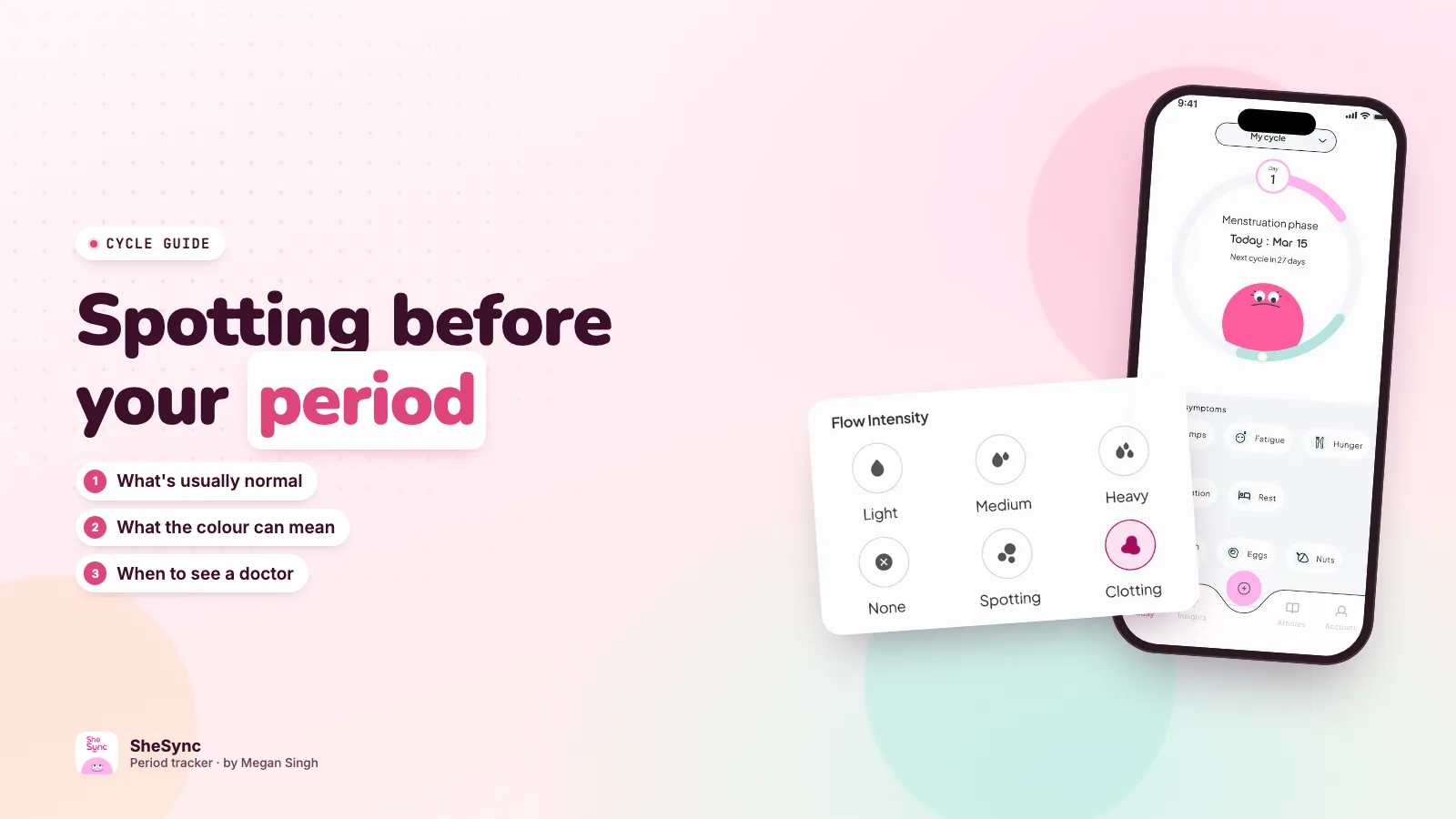
In SheSync, flow is one tap: light, medium or heavy, plus spotting, clotting or nothing at all. You can log symptoms and mood alongside it, and SheSync accounts for your contraception, whether that's the pill, mini pill, implant, ring or temperature tracking. Logging is free on iPhone and Android, and you can keep a simple symptom diary for your appointment.
Frequently asked questions
Is spotting a week before my period normal?
It can be, especially if you have recently started or changed hormonal contraception, or missed a pill. But healthdirect advises seeing your doctor about bleeding between periods, particularly if it is new or keeps happening.
Does spotting count as day one of my period?
Jean Hailes describes day one as the first day of your period, when you start to bleed, and notes that some people only have spotting on their first day. If you spot for a day or two and then your period starts properly, I would log the spotting as spotting and day one as the day your flow begins. Whatever you choose, be consistent so your predictions stay useful.
Can stress cause spotting before a period?
healthdirect lists stress among the factors that can cause irregular periods, and Cleveland Clinic includes stress among hormone disruptions that can cause abnormal bleeding. It is still worth seeing your GP to rule out other causes.
Can the pill or an IUD cause spotting?
Yes. healthdirect says bleeding between periods often happens when you start hormonal contraception, or if you miss pills, and Family Planning NSW says spotting is normal in the first few months after a hormonal IUD is inserted.
Should I take a pregnancy test if I'm spotting?
If there is any chance you are pregnant, yes. Tests are most reliable from the first day of your missed period, or at least 21 days after unprotected sex. If you have spotting with tummy pain and could be pregnant, go to an emergency department or call 000.
Read next
- Ovulation symptoms7 signs your body gives
- Tracking your period on the pillWhat bleeding to expect
- Why is my period late?10 common reasons
- Period bloatingWhy it happens and what helps
Sources
- Bleeding between periods, healthdirect
- Vaginal bleeding in pregnancy, NHS
- Vaginal bleeding between periods or after sex, NHS
- Hormonal IUD, Family Planning NSW
- Vaginal bleeding: irregular, Better Health Channel
- What does the color of your period mean?, Cleveland Clinic
- Periods, NHS
- Periods, Jean Hailes
- Tricky periods: what's normal and what's not, Jean Hailes
- Implantation bleeding, Cleveland Clinic
- Doing a pregnancy test, NHS
- Pregnancy testing, Better Health Channel
- Ectopic pregnancy, healthdirect
- Heavy periods, healthdirect
- Bleeding after menopause, healthdirect
- Cervical screening test, healthdirect
- Irregular periods, healthdirect
- Abnormal uterine bleeding, Cleveland Clinic
Last updated 14 November 2026. This is general information, not medical advice, and SheSync is not a contraceptive. If you're worried about bleeding between periods, see your GP. If you're bleeding very heavily, feel faint, or could be pregnant and have tummy pain, call 000 or go to an emergency department.