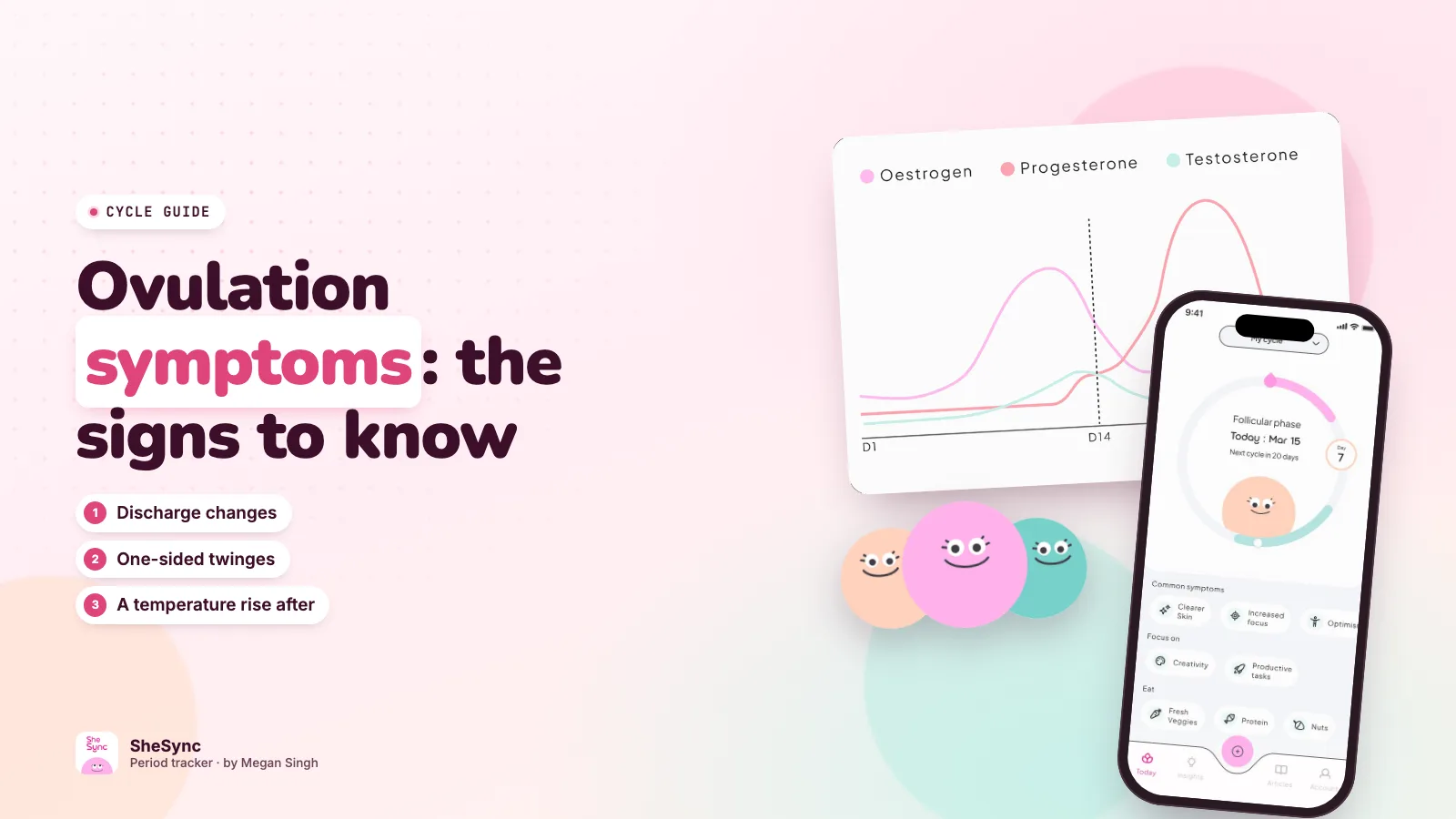
The most common ovulation symptoms are a change in your vaginal discharge (it goes clear, slippery and stretchy, like raw egg white), a one-sided twinge low in your tummy, and a small rise in your resting temperature once ovulation has happened. Some people also notice tender breasts, a higher sex drive or a little spotting, and plenty of people notice nothing at all.
I'm Megan, and I lead design on SheSync. "How do I actually know when I'm ovulating?" is one of the most common cycle questions, so here's an honest answer, with sources.
At a glance: 7 signs of ovulation
| Sign | What you might notice | When |
|---|---|---|
| 1. Discharge changes | Clear, slippery and stretchy, like raw egg white | Around ovulation |
| 2. Ovulation pain | A twinge or ache on one side of your lower tummy | Minutes to a day or two |
| 3. Temperature rise | Resting temperature up about 0.2 to 0.5°C | After ovulation |
| 4. Light spotting | A little bleeding or discharge | Around ovulation |
| 5. Tender breasts | Soreness or sensitivity | Around ovulation |
| 6. Higher sex drive | Feeling more interested in sex | Around ovulation |
| 7. Other changes | Bloating, mood or appetite changes, sharper senses | Varies |
What are the most common ovulation symptoms?
- Changes in cervical mucus. healthdirect describes fertile mucus as having a texture like raw egg whites: clearer, more watery and elastic. It's the most reliable sign you can see.
- Ovulation pain. Some people feel a twinge or ache on one side of the lower tummy. Better Health Channel says about 40% of women get pain during ovulation.
- A small rise in basal body temperature. Your resting temperature rises slightly, by about 0.2 to 0.5°C, after you ovulate, so it confirms ovulation rather than predicting it.
- Light spotting. The NHS notes you may have a little vaginal bleeding or discharge during ovulation.
- Tender breasts.
- An increased sex drive.
- Other changes, which Cleveland Clinic lists as bloating, a heightened sense of smell, taste or sight, and changes in mood or appetite.
When does ovulation happen in your cycle?
Ovulation usually happens about 14 days before your next period starts, not on day 14 of every cycle. Your Fertility, the Australian government-funded fertility site, gives the examples: in a 21-day cycle that's around day 7, and in a 35-day cycle it's around day 21. A cycle of 21 to 35 days is considered normal.
That's because the second half of your cycle (the luteal phase) is fairly steady from person to person, while the first half varies more. A research review of menstrual cycle studies puts the average luteal phase at about 13 days, with most falling between 9 and 18. So if your cycles are longer or shorter than 28 days, a "day 14" calendar will be off. Cycle syncing 101 explains all four phases in plain English.
Your fertile window is the day you ovulate and the five days before it. healthdirect explains why: sperm can live in the body for up to 5 days, but the egg survives only 12 to 24 hours.
What does ovulation discharge look like?
As you get closer to ovulation, discharge usually becomes wetter, clearer and stretchier. If you can stretch it between two fingers without it breaking, that's the "raw egg white" texture healthdirect describes. healthdirect notes that normal discharge changes throughout your cycle, so checking it for a few cycles is the best way to learn your own pattern.
healthdirect also says discharge isn't normal if it's thick and white, yellow or green, or smells unpleasant. See your GP if you notice that, or itching or pain, because those aren't ovulation signs.
Is ovulation pain normal?
Yes, for many people. The NHS says ovulation pain affects one side of the tummy at a time and lasts from a few minutes to a day or two. It's usually mild.
Better Health Channel advises seeing a doctor if ovulation pain lasts longer than three days, comes with heavy bleeding or unusual discharge, or is severe, because severe pain can have other causes such as endometriosis, appendicitis or pelvic inflammatory disease. Cleveland Clinic adds a fever of 38°C or more to that list.
Ovulation symptoms vs PMS: how can you tell?
Timing is the giveaway. healthdirect says PMS symptoms usually happen in the second half of your cycle and stop shortly after your period begins; Jean Hailes puts it as the week or two before your period. Ovulation signs cluster around the middle.
The confusing part is that some symptoms, like sore breasts and bloating, can show up at both times. Logging symptoms for a few cycles makes the pattern obvious. If you're tracking a late period, why is my period late? covers the common reasons.
Can a period tracker tell you when you ovulate?
A tracker can estimate it, and that's the honest word. Predictions from dates alone can be well off: one study of fertility apps found their ovulation predictions were accurate no more than 21% of the time (the authors worked for a company that makes ovulation tests, which is worth knowing). Accuracy improves when you combine signs:
- Ovulation predictor kits detect a hormone surge; Your Fertility says a positive result means you're likely to ovulate within the next 24 to 36 hours. ACOG notes that with very irregular periods, predicting ovulation at home isn't worth your time or money.
- Basal body temperature confirms ovulation after it's happened, once you've logged it for a while.
- Cervical mucus shows your fertile days approaching.
In SheSync, your ovulation and fertile window are predicted from your own cycles, not a textbook 28 days, and you can log flow, symptoms and mood, plus your morning temperature, which SheSync charts across every phase once you've logged it five times. You can also try the free period and ovulation calculator.
A predicted fertile window isn't contraception. SheSync is a tracking and education tool, not a contraceptive. Fertility awareness methods are only about 76% effective if the instructions aren't followed exactly, according to the NHS, and healthdirect doesn't recommend them if your periods are irregular, you've recently stopped hormonal contraception or you're nearing menopause. More in can you use a period tracker as birth control?
When should you see a doctor?
- Ovulation pain that lasts more than three days, is severe, or comes with heavy bleeding, unusual discharge or a fever.
- Periods that come less than 21 days apart, or more than two to three months apart (Better Health Channel).
- Trying to get pregnant for 12 months if you're under 35, or for 6 months if you're 35 or over (healthdirect).
- Any chance you might have PCOS or endometriosis.
If your cycles are all over the place, our guide to irregular periods covers what to log before your appointment.
Frequently asked questions
Can you ovulate without any symptoms?
Yes. Cleveland Clinic notes that not everyone has signs or symptoms of ovulation, and Better Health Channel says only about 40% of women get ovulation pain. No symptoms does not mean you are not ovulating.
How long do ovulation symptoms last?
Ovulation pain usually lasts from a few minutes to a day or two. The egg itself survives only 12 to 24 hours after it is released, while fertile-type discharge tends to appear over the few days leading up to ovulation.
Can you feel which side you ovulate from?
Sometimes. The NHS says ovulation pain affects only one side of the tummy at a time, which is why some people feel it on the left one month and the right another.
Do ovulation tests work with irregular cycles?
They can be harder to use. ACOG says that if your periods are highly irregular, trying to predict ovulation at home is not worth your time or money, so talk to your GP instead.
Is a period app's fertile window safe to use as contraception?
No. A predicted fertile window is an estimate, and SheSync is not a contraceptive. The NHS says fertility awareness is only about 76% effective if the instructions are not followed exactly. Talk to your GP or a sexual health clinic about contraception that suits you.
Read next
- Cycle syncing 101The four phases of your cycle in plain English
- Period tracker as birth control?Why a fertile window isn't contraception
- Spotting before your periodWhat's normal, and when to see a doctor
- Why is my period late?10 common reasons
Sources
- Timing and fertility, Your Fertility
- Fertility awareness (natural family planning), healthdirect
- Ovulation pain, NHS
- Ovulation pain, Better Health Channel
- Menstrual cycle, Better Health Channel
- Ovulation, Cleveland Clinic
- Premenstrual syndrome (PMS), healthdirect
- Premenstrual syndrome (PMS), Jean Hailes
- Trying to get pregnant? Here's when to have sex, ACOG
- Natural family planning, NHS
- About infertility, healthdirect
- How to study the menstrual cycle: practical tools and recommendations (Schmalenberger et al., 2021), Psychoneuroendocrinology
- Can apps and calendar methods predict ovulation with accuracy? (Johnson et al., 2018), Current Medical Research and Opinion
- Vaginal discharge, healthdirect
Last updated 14 November 2026. This is general information, not medical advice, and SheSync is not a contraceptive. For questions about your cycle, fertility or contraception, talk to your GP or a sexual health clinic. In an emergency in Australia, call 000.