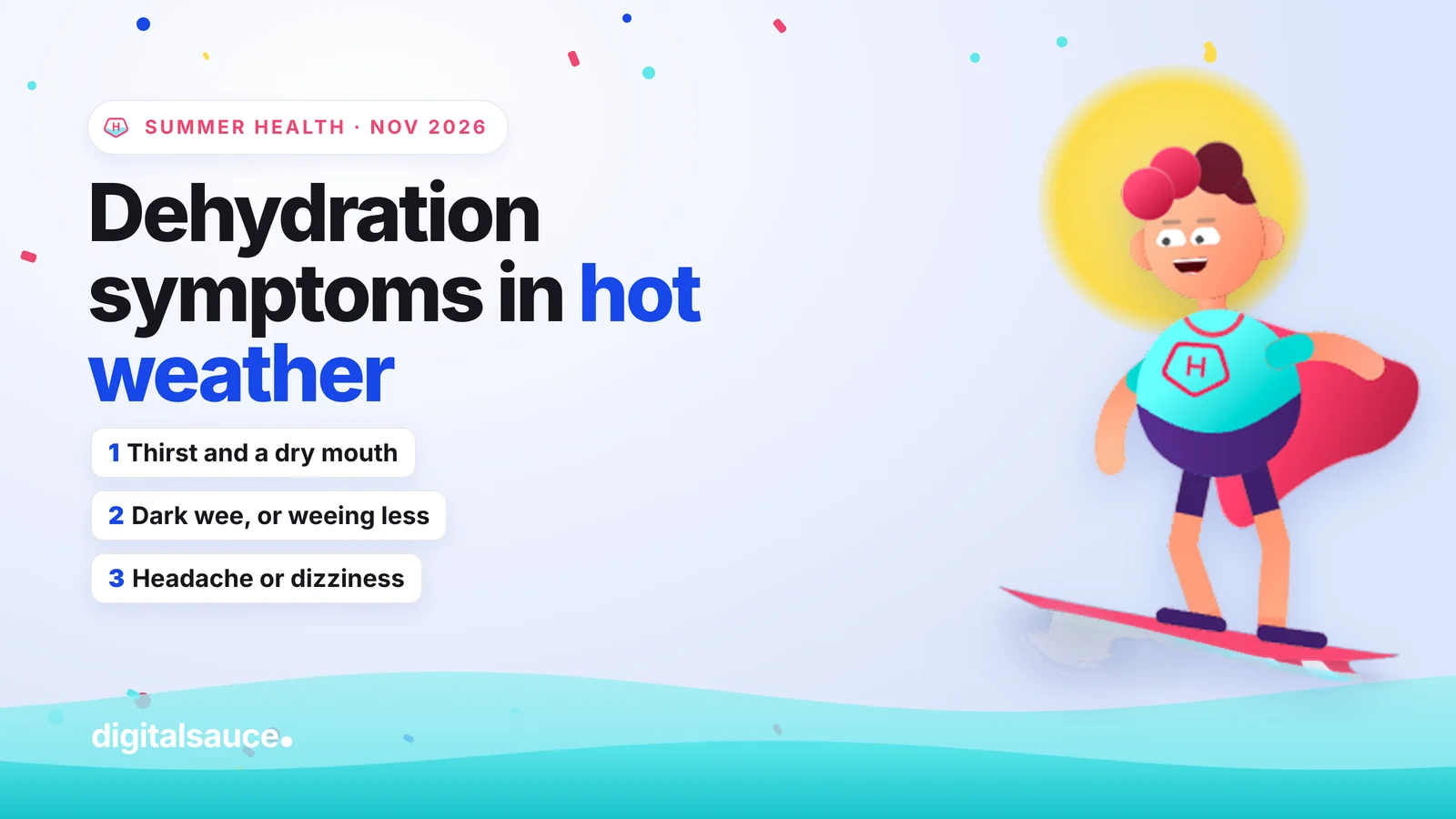
The first dehydration symptoms in hot weather are thirst, a dry mouth, dark or less frequent wee, a headache and feeling dizzy or tired. If you notice them, get somewhere cool and sip water; if someone becomes confused, collapses or stops making sense, that's heatstroke territory, so call 000.
TL;DR
- Early signs: thirst, dry mouth, dark wee, headache, dizziness, tiredness.
- Fix it early: shade or air con, rest, small regular sips of water.
- Emergency: confusion, slurred speech, collapse or a seizure in the heat. Call 000.
- Most at risk: people over 65, babies and young kids, pregnant women, outdoor workers and people with health conditions.
- Stay ahead: drink before you're thirsty and carry a bottle every time you leave home.
I'm Sanket, and I make the water tracker Hydration Hero at my studio in Melbourne. I'm not a doctor, so everything health-related here comes from healthdirect and Victoria's Better Health Channel (sources at the bottom).
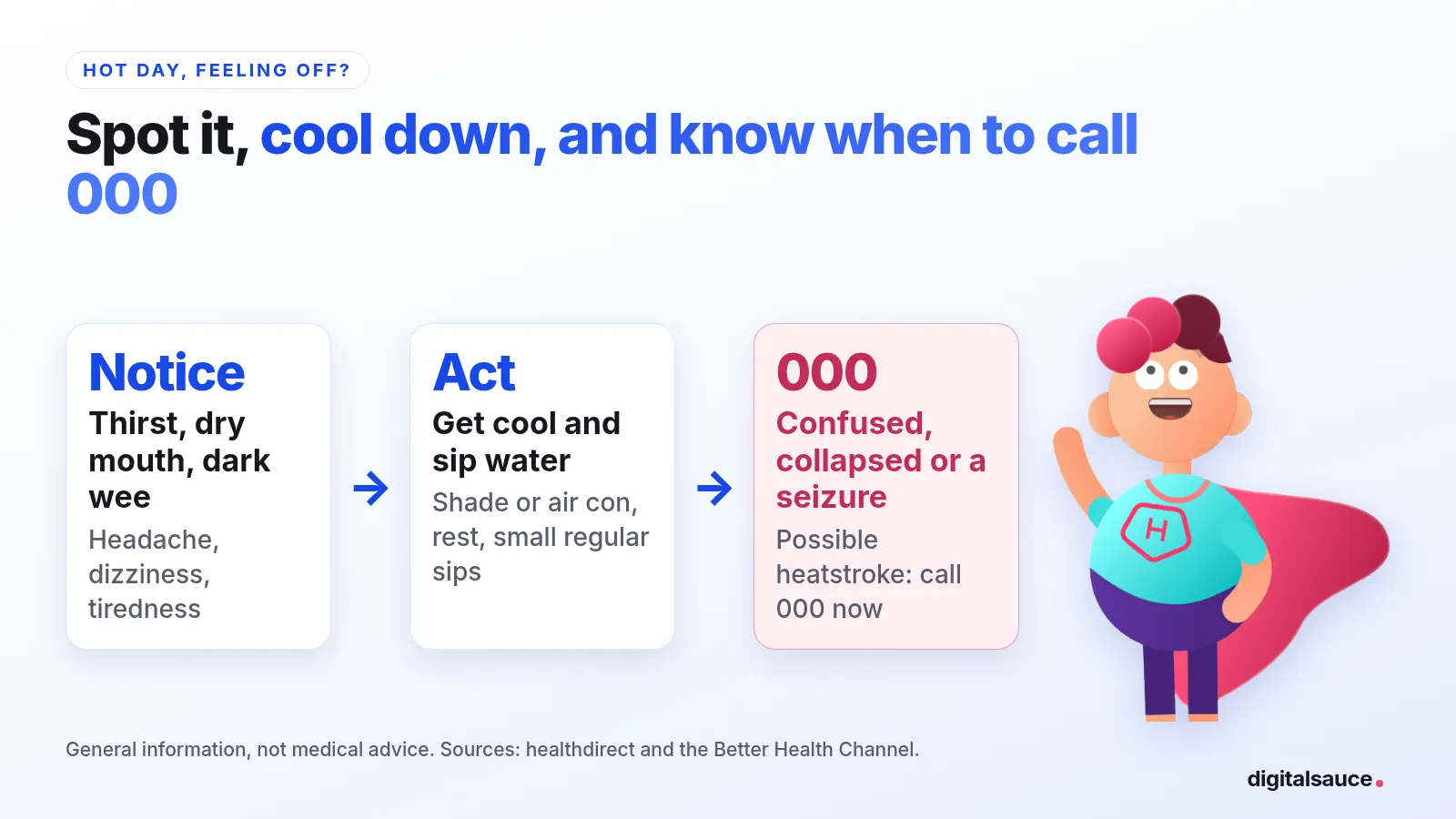
General information, not medical advice. In an emergency in Australia, call 000. For 24-hour health advice, call healthdirect on 1800 022 222 (also known as NURSE-ON-CALL in Victoria).
What are the signs of dehydration in hot weather?
Dehydration means your body doesn't have enough fluid to work properly. In the heat you lose more through sweat, so it can creep up fast, especially if you're busy and not drinking.
healthdirect lists these signs of mild to moderate dehydration:
- feeling thirsty
- a dry mouth, lips and tongue
- dark-coloured wee, or weeing less often than usual
- a headache
- feeling dizzy or light-headed, especially when you stand up
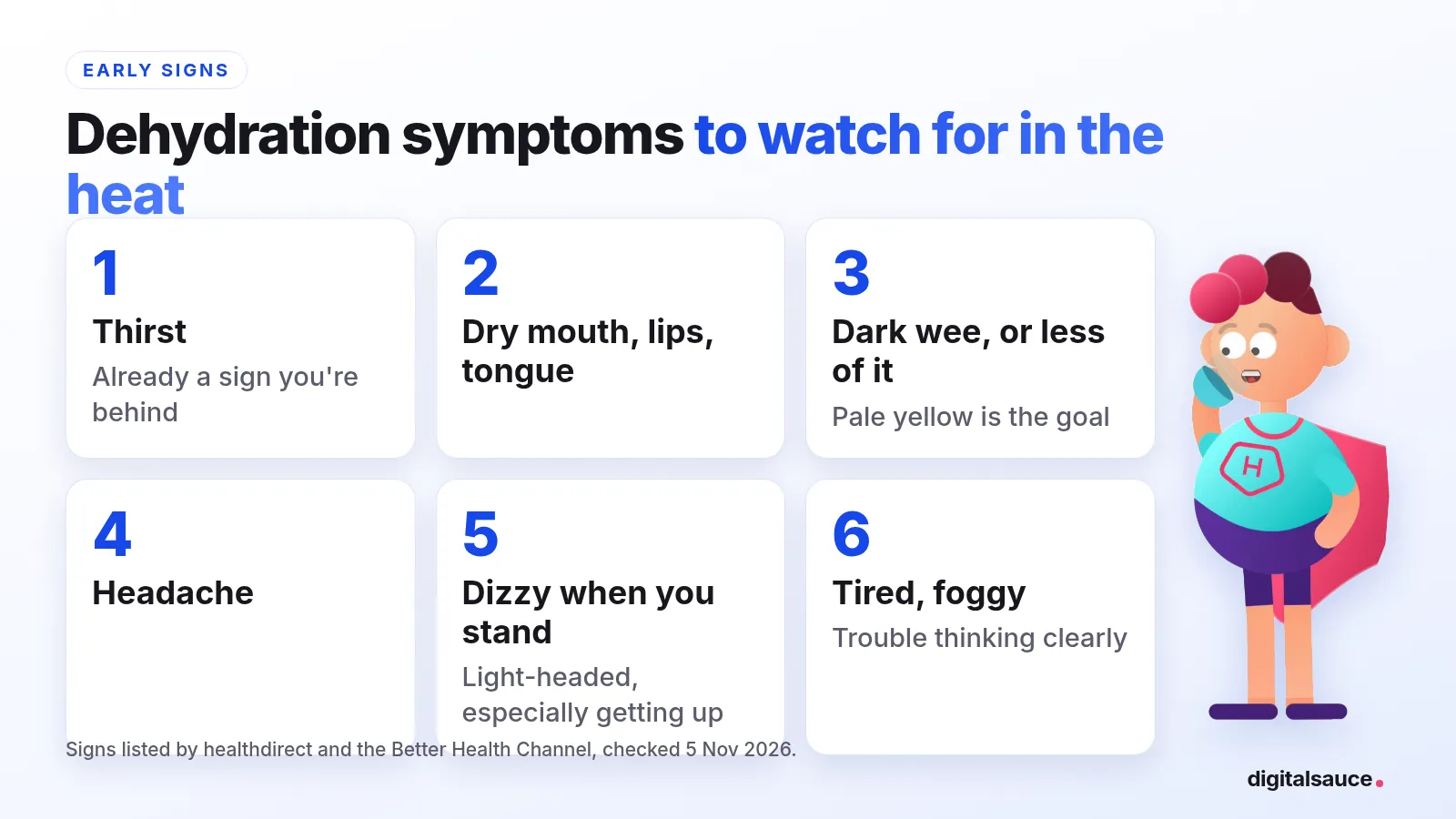
The Better Health Channel adds tiredness, trouble thinking clearly and strong-smelling wee. The quickest daily check is your wee: pale yellow is the goal, darker means drink up.
Kids show it differently. Babies and toddlers have fewer wet nappies (or nappies that aren't as wet), and older kids may not go to the toilet as often.
Mild or serious: when should you get help?
Dehydration on a hot day can slide into heat exhaustion, and heat exhaustion can turn into heatstroke, which is life-threatening. Here's how the three compare.
| Stage | What you might notice | What to do |
|---|---|---|
| Dehydration (mild to moderate) | Thirst; dry mouth, lips and tongue; dark wee or weeing less; headache; dizziness when you stand up; tiredness | Move somewhere cool, rest, and sip water through the day. See a GP or call healthdirect (1800 022 222) if it doesn't improve. |
| Heat exhaustion | Heavy sweating; pale skin; weakness or feeling faint; dizziness, headache; nausea or vomiting; muscle cramps | Lie down somewhere cool with your legs raised, loosen clothing, cool the skin, and take frequent sips of cool water if not vomiting. Get medical care if it isn't improving. |
| Heatstroke (emergency) | Confusion, slurred speech or strange behaviour; poor coordination; seizures or collapse; very high body temperature; red, hot, dry skin; fast breathing | Call 000 now. Move them somewhere cool, remove excess clothing, cool them with water, wet cloths or ice packs, and only give sips of water if they're fully awake and able to swallow. |
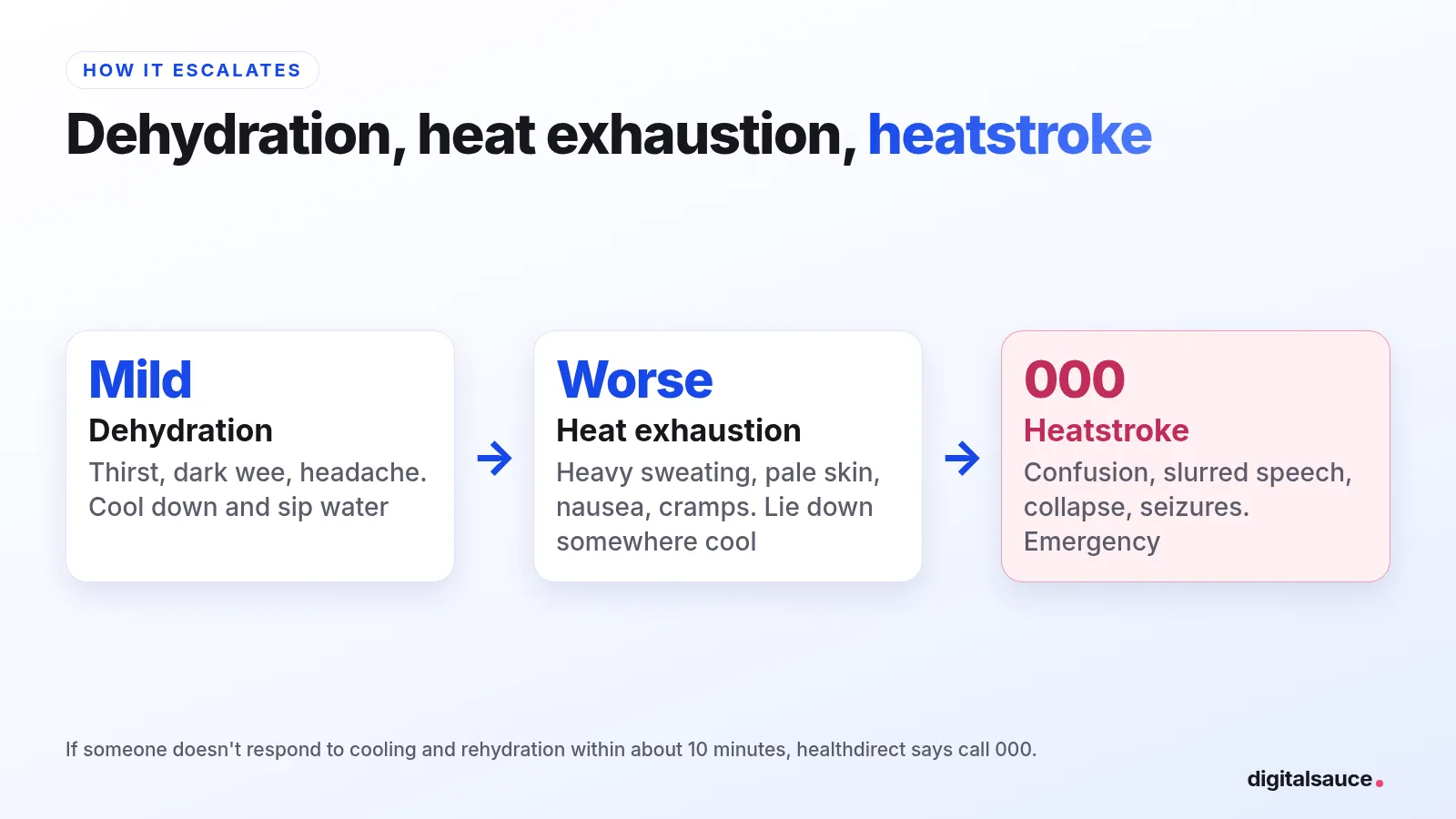
Call 000 straight away if someone in the heat is confused, has slurred speech, collapses, has a seizure or loses consciousness. healthdirect also says to call 000 if someone is very unwell and doesn't respond to cooling and rehydration within about 10 minutes.
For anything milder that isn't getting better, see your GP or call healthdirect on 1800 022 222. In Victoria that same national helpline is also known as NURSE-ON-CALL. Severe dehydration (extreme thirst, fast breathing and heart rate, confusion, cold hands and feet, sunken eyes) needs urgent medical care too.
One more from healthdirect: if a baby under six months shows even mild signs of dehydration, see a doctor as soon as possible. Young babies can go from mild to severe very quickly.
Who is most at risk in an Aussie heatwave?
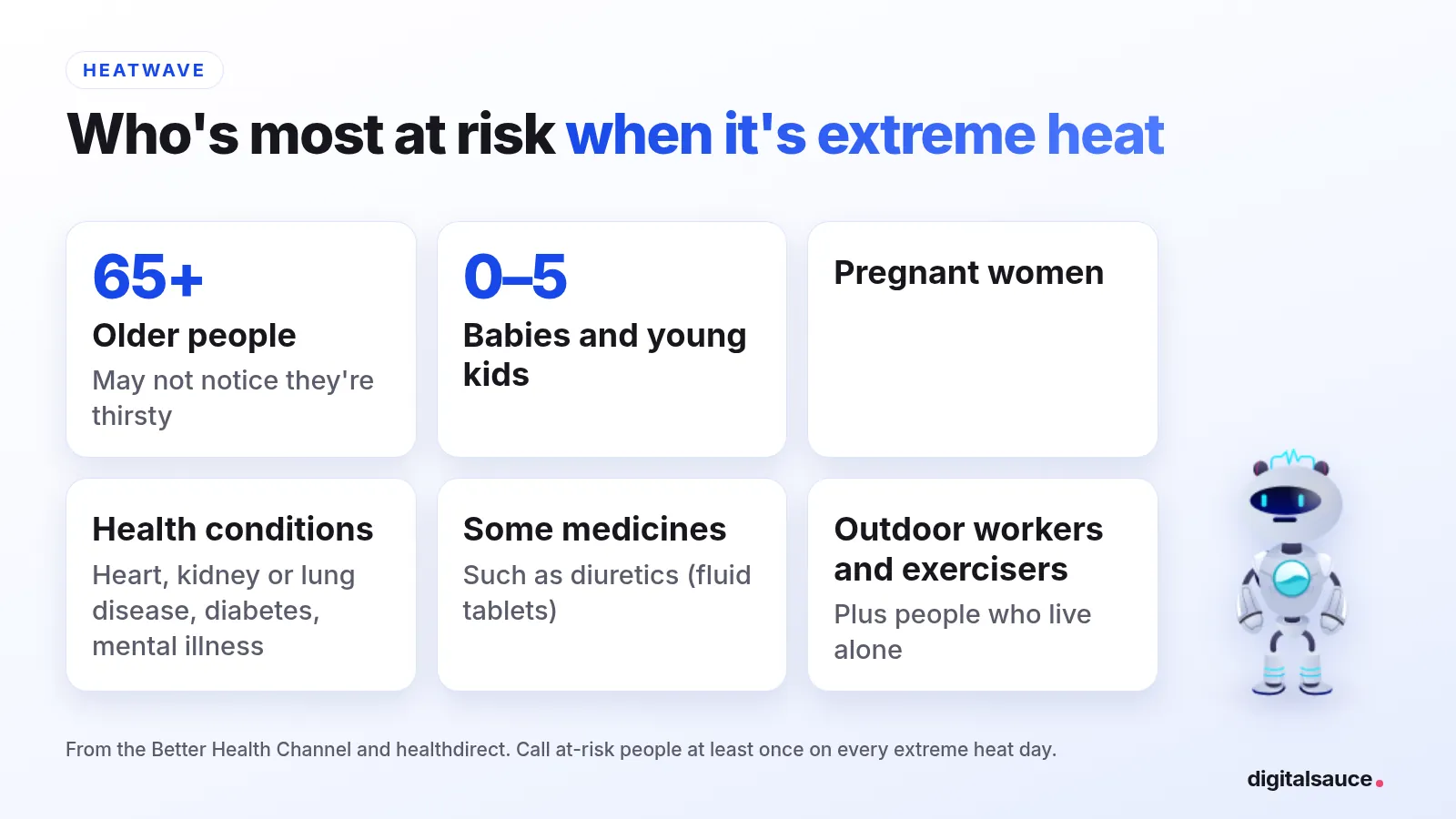
Anyone can get sick in extreme heat. The Better Health Channel calls heat the natural disaster that kills more Australians than any other. Some people are at much higher risk:
- people over 65, who may not notice they're thirsty
- babies and young children
- pregnant women
- people with heart, kidney or lung disease, diabetes or mental illness
- people on some medicines, such as diuretics (fluid tablets)
- people who work or exercise outdoors
- people who live alone or can't keep their home cool
healthdirect describes a heatwave as three or more days in a row where the minimum and maximum temperatures are hotter than usual. The Bureau of Meteorology publishes heatwave forecasts on its website and app, and the Better Health Channel suggests keeping an eye on them.
If someone you love is on that list, call them at least once on every extreme heat day. That's straight from the Better Health Channel, and it's the simplest thing on this page that can actually save a life.
How do you stay ahead of thirst on a hot day?
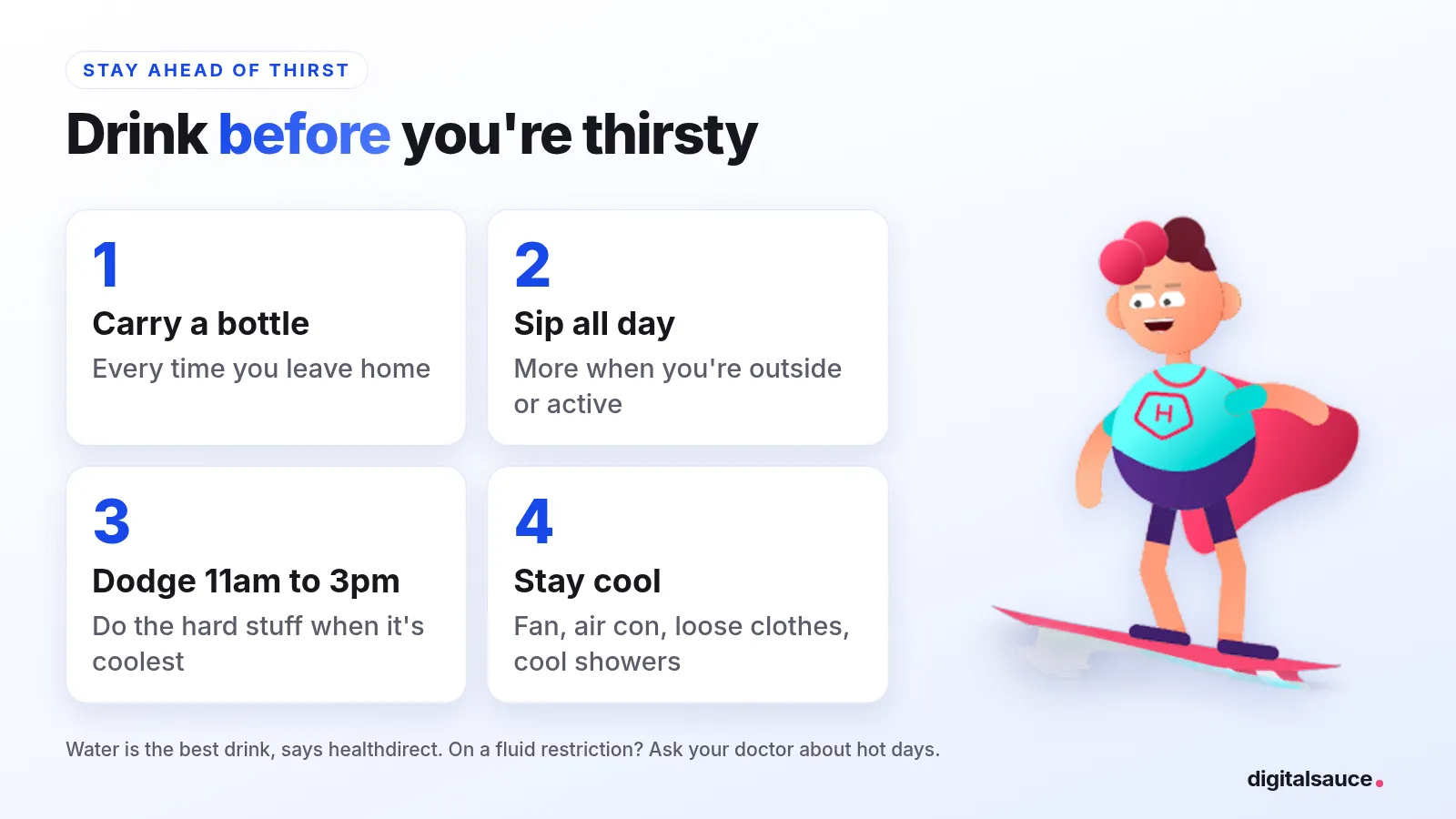
The trick is to drink before you're thirsty. By the time thirst kicks in, you're already behind. These come from the Better Health Channel and healthdirect:
- Carry water every time you leave home. A bottle in the car, the bag, the ute.
- Keep sipping through the day, even before you feel thirsty, and more if you're outside or active.
- Plan around the heat. Do the hard stuff in the coolest part of the day; healthdirect suggests avoiding being outdoors between 11am and 3pm.
- Stay cool: air con or a fan, light loose clothes, cool showers, closed blinds.
- Check your wee. Pale yellow is the target.
What should you drink? healthdirect says water is the best drink to hydrate your body. If you're already dehydrated, it suggests small, frequent sips of water or an oral rehydration solution, which replaces fluids and salts, and says to skip soft drinks, sports drinks, caffeine and alcohol until you've recovered.
If your doctor has told you to limit fluids (for example, for a heart or kidney condition), don't just drink more. The Better Health Channel says to ask your doctor how much to drink during extreme heat.
How much more water do you need on a hot day?
There's no single official number. healthdirect's everyday guide is about 2.1 to 2.6 litres of fluids a day for adults, with extra when it's hot, when you're exercising and when you're sick.
To turn "extra" into something you can aim for, Hydration Hero uses these top-ups. They're my app's logic, not a medical limit, so spread any top-up across the day rather than forcing it down at once.
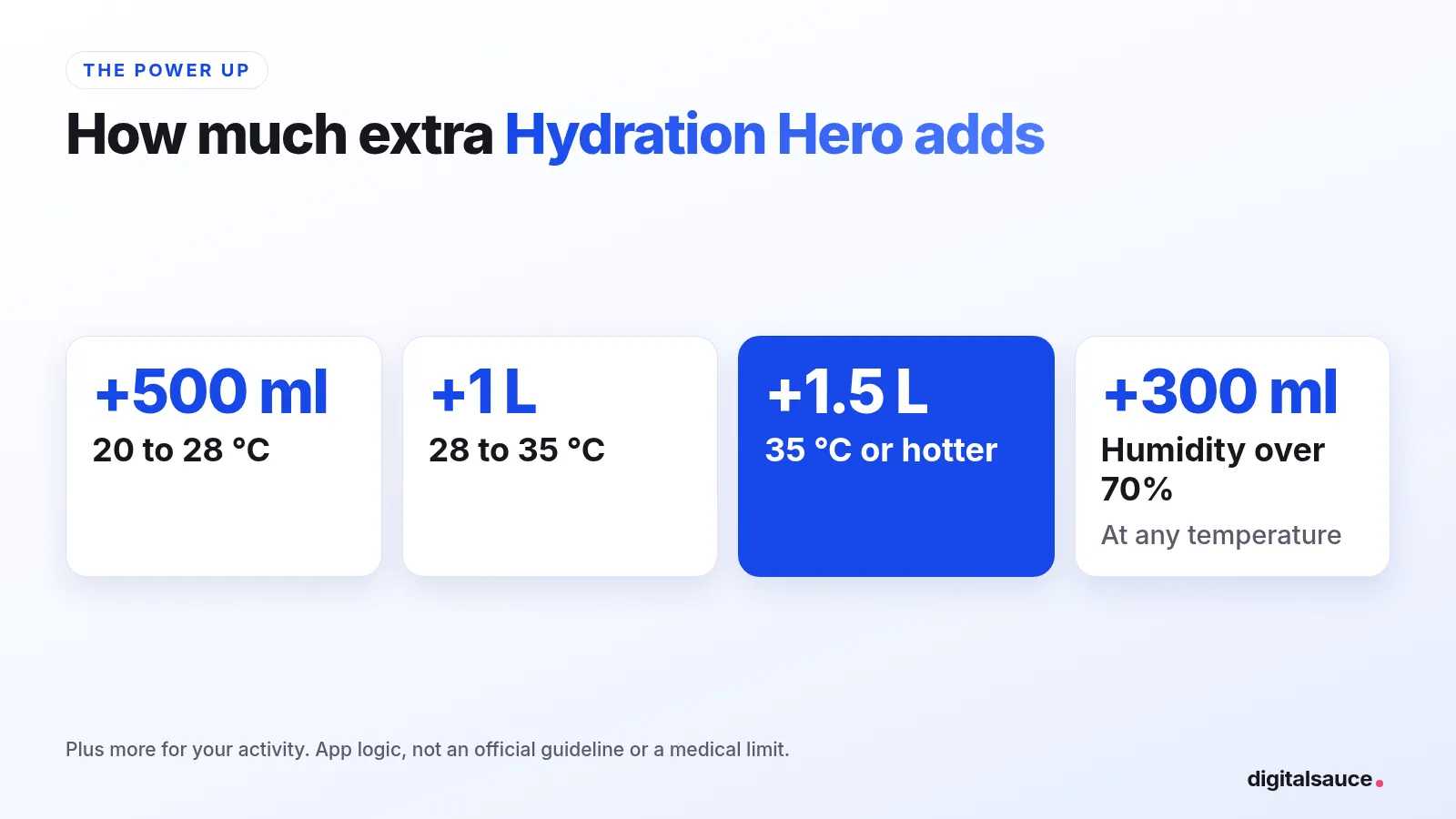
| Temperature | Added to your daily goal | If humidity is over 70% |
|---|---|---|
| Below 20 °C | Nothing extra | +300 ml |
| 20 to 28 °C | +500 ml | +800 ml in total |
| 28 to 35 °C | +1,000 ml | +1,300 ml in total |
| 35 °C or hotter | +1,500 ml | +1,800 ml in total |
Try it: how much would the app add today?
+1,000 ml on top of your usual daily goal, spread across the day.
Want your full personal number, not just the hot-day extra? The free water intake calculator works it out from your weight, exercise and the weather.
This page is about recognising dehydration symptoms in the heat. For how much water to drink when you exercise or train in hot weather, see How much water to drink for exercise and hot weather.
How does Hydration Hero's Power Up help?
Knowing you should drink more on a 38 °C day is easy. Remembering to, between work, kids and errands, is the hard bit. That's why I built Hydration Hero.
Its Power Up raises your daily water goal with the weather and your activity: for example, if you worked out or ran, you need more water, and a hotter day adds more on top. In the App Store listing it reads "Goals that adapt to your day: built for Aussie heat", and the goal screen shows how much was added for the weather in your area and for your activity. Then it sends gentle reminders at intervals you choose.
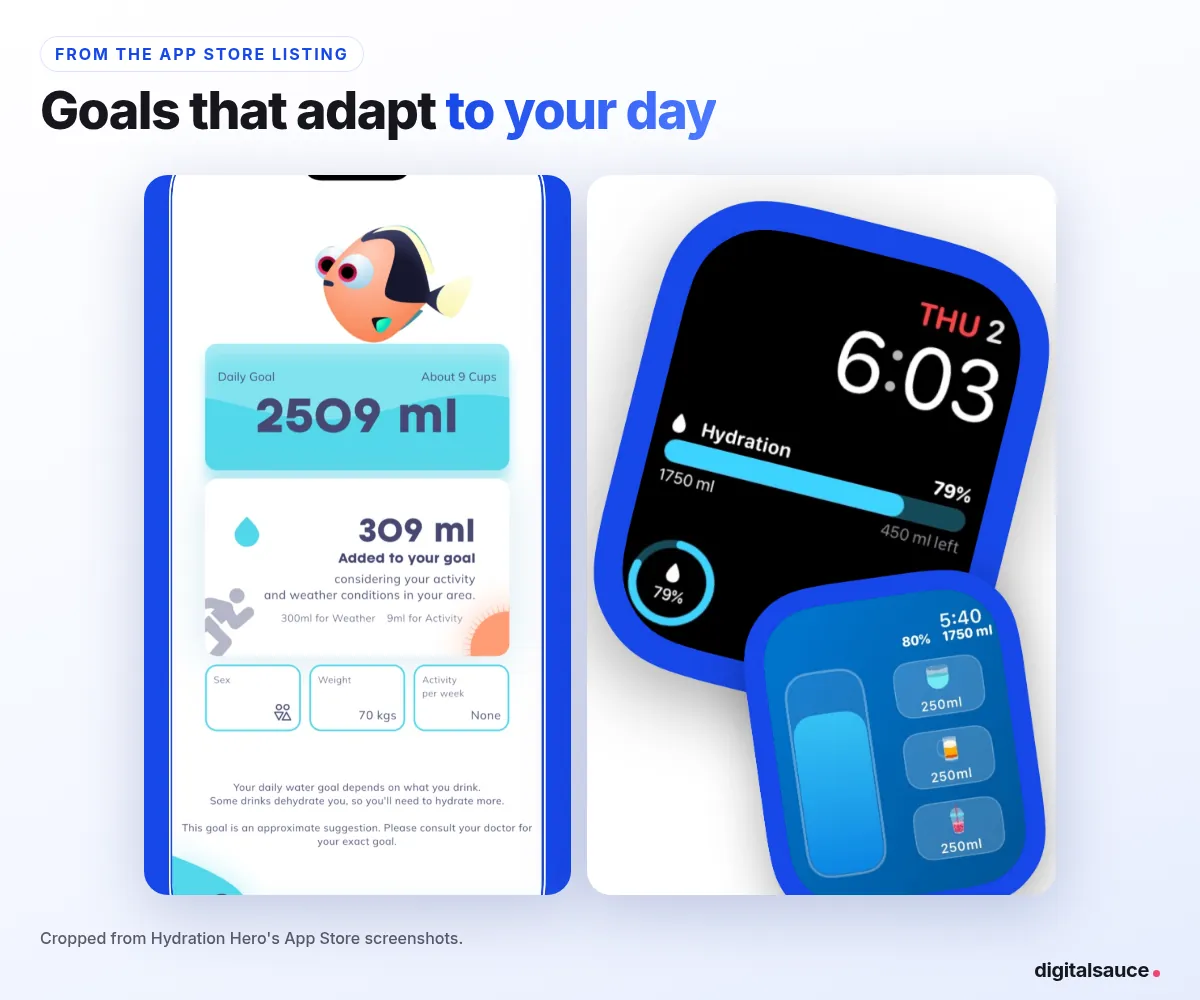
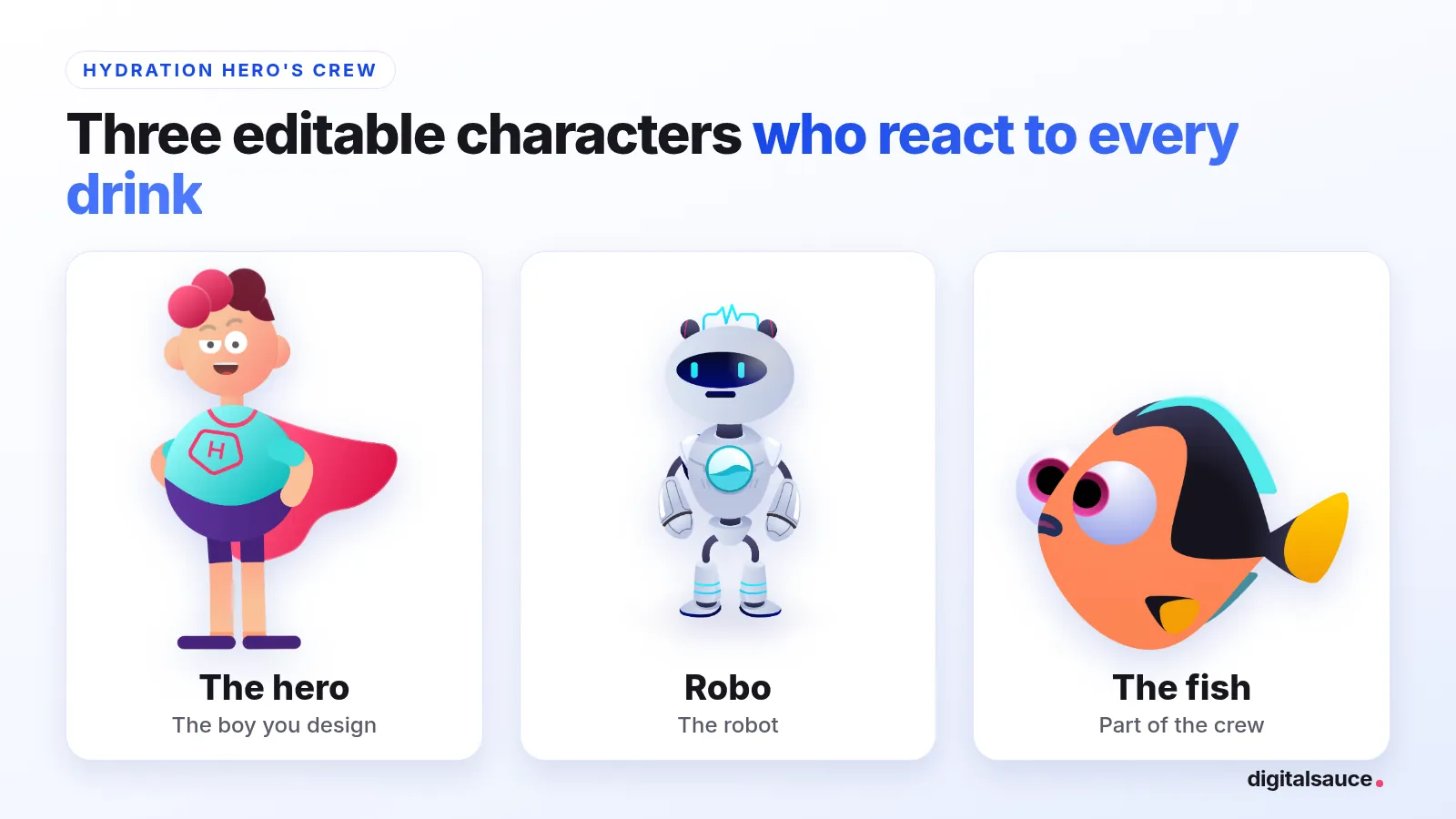
There's a small game in it, too. You pick from three characters you can edit: the hero, Robo the robot, or a fish. They react to every drink you log, a bit like a Tamagotchi: keep them hydrated and they stay happy. On Apple Watch you can log water with one tap on your wrist, handy when your phone is in the beach bag.
It's free to download and track water on iPhone, iPad and Apple Watch and on Android, with optional in-app purchases to unlock other features.
Where it doesn't fit: it's a habit tool, not a medical device. It can't tell whether you're dehydrated, and it won't spot heat exhaustion. If you're on a fluid restriction, follow your doctor's number, not an app's. And if you'd rather not use an app, a marked bottle and the wee check work fine.
Frequently asked questions
What are the first signs of dehydration?
The first signs are usually thirst, a dry mouth, lips and tongue, dark-coloured wee or weeing less often, a headache, and feeling dizzy or light-headed when you stand up, according to healthdirect. Tiredness and trouble thinking clearly are common too. Move somewhere cool and sip water. If symptoms don't improve, see a GP or call healthdirect on 1800 022 222.
Is an electrolyte drink better than water in the heat?
For most people on a hot day, water is enough: healthdirect calls it the best drink to hydrate your body. If you're already dehydrated, healthdirect suggests small, frequent sips of water or an oral rehydration solution, which replaces fluids and salts, and says to avoid sugary drinks such as soft drinks and sports drinks. Ask a pharmacist which rehydration solution suits you.
How much more water do I need on a hot day?
There's no single official amount. healthdirect suggests about 2.1 to 2.6 litres of fluids a day for adults, plus extra in hot weather and when you exercise. As a rough guide, Hydration Hero adds 500 ml at 20 to 28 °C, 1 litre at 28 to 35 °C and 1.5 litres at 35 °C or hotter, plus 300 ml when humidity is over 70%. If your doctor limits your fluids, ask them instead.
When is dehydration an emergency?
Call 000 if someone in the heat is confused, has slurred speech, collapses, has a seizure, loses consciousness, or doesn't respond to cooling and rehydration within about 10 minutes. These can be signs of heatstroke, which is life-threatening. Signs of severe dehydration, such as extreme thirst, fast breathing and heart rate, sunken eyes and cold hands and feet, also need urgent medical care.
How can I tell if an older person is dehydrated?
Older people may not notice they're thirsty, so don't wait for them to ask for a drink: remind them to drink regularly, and watch for the usual signs such as dark wee, weeing less, dizziness and tiredness. healthdirect notes dehydration in older people can lead to confusion, constipation and falls. In an Australian heatwave, the Better Health Channel suggests calling older friends and relatives at least once on any extreme heat day and helping them get somewhere cool. If they have a health condition, they should ask their doctor about heat precautions.
Related reading
- Water intake calculator: your daily water number, adjusted for exercise and weather
- How much water to drink for exercise and hot weather: how much to drink when you train or exercise in the heat (this page is the symptoms checklist)
- How much water should you drink a day?: the guidelines, explained
- Does coffee count as water?: what caffeine really does to hydration
- Hydration Hero: the water tracker with weather-adjusted goals, reminders and characters that react to every drink
- How much water should I drink on creatine?: a daily water target if you take creatine
- How to set up a drink water reminder app: reminders that keep you ahead of thirst on hot days
- All posts on the blog
Sources
- Dehydration, healthdirect Australia (last reviewed May 2026)
- Heatstroke, healthdirect Australia (last reviewed May 2026)
- Hot weather risks and staying cool, healthdirect Australia (last reviewed December 2024)
- Heat-related health problems, Better Health Channel, Victorian Department of Health (reviewed 9 December 2024)
- How to cope and stay safe in extreme heat, Better Health Channel, Victorian Department of Health (reviewed 9 December 2024)
- Heatwave forecasts, Bureau of Meteorology
Written by Sanket Singh, founder of Digital Sauce, and checked against the sources above on 5 November 2026. This is general information, not medical advice. If you're worried about yourself or someone else, see a doctor or call healthdirect on 1800 022 222. In an emergency in Australia, call 000.